MCQ
Necessary conditions for halogenation are
  • A
    Cold and dark
  • B
    Presence of halogen carrier
  • Both $(a)$ and $(b)$
  • D
    None

Answer

Correct option: C.
Both $(a)$ and $(b)$
c
Necessary condition for halogenation is presence of halogen carrier.

Halogenation is done in dark without any catalyst then according to free radical mechanism new halide radical will be attached to benzylic carbon. This reaction is carried out in dark so that required energy is supplied in general if it would be carried out in light chlorine free radical would be formed but in dark we use heat and supply energy. For chlorination $1\, kcal$, bromination $16\, kcal$ and iodination $33\, kcal$.

in presence of catalyst like lewis acid like $AlCl _3$ and $FeCl _3$ electrophilic substitution takes place.

Need a full question paper?

Generate a complete, print-ready paper with questions like this in minutes — across 16+ boards, with answer keys.

Start Generating Free

Similar questions

A substance which alters the rate of reaction:
Primary aldehyde on oxidation gives
The rate of the first$-$order reaction is $0.69 \times 10^{-2} mol \ L^{-1} min^{-1}$ and the initial concentration is $0.2 \ mol \ L^{-1}$ the half$-$life period is$:$
The octahedral complex of a metal ion $M^{3+}$ with four monodentate ligands $L_1, L_2, L_3$ and $L_4$ absorb wave lengths in the region of red, green, yellow and blue, respectively. The increasing order of ligand strength of the four ligands is :
$ \mathrm{Ag}^{+}+\mathrm{NH}_3 \rightleftharpoons\left[\mathrm{Ag}\left(\mathrm{NH}_3\right)^{+}\right] ; \mathrm{k}_1=3.5 \times 10^{-3} $

$ {\left[\mathrm{Ag}\left(\mathrm{NH}_3\right)\right]^{+}+\mathrm{NH}_3 \rightleftharpoons\left[\mathrm{Ag}\left(\mathrm{NH}_3\right)_2\right]^{+} ; \mathrm{k}_2=1.7 \times 10^{-3}}$

then the formation constant of $\left[\mathrm{Ag}\left(\mathrm{NH}_3\right)_2\right]^{+}$is
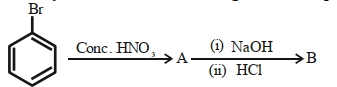
$\mathrm{NO}_2$ required for a reaction is produced by decomposition of $\mathrm{N}_2 \mathrm{O}_5$ in $\mathrm{CCl}_4$ as by equation $2 \mathrm{~N}_2 \mathrm{O}_{5(\mathrm{~g})} \rightarrow 4 \mathrm{NO}_{2(\mathrm{~g})}+\mathrm{O}_{2(\mathrm{~g})}$The initial concentration of $\mathrm{N}_2 \mathrm{O}_5$ is $3 \mathrm{~mol} \mathrm{~L}^{-1}$ and it is $2.75 \mathrm{~mol} \mathrm{~L}^{-1}$ after 30 minutes.The rate of formation of $\mathrm{NO}_2$ is $\mathrm{x} \times 10^{-3} \mathrm{~mol} \mathrm{~L}^{-1}$ $\min ^{-1}$, value of $x$ is______.
Identify $\mathrm{A}$ and $\mathrm{B}$ in the following reaction sequence.
Product $Z$ of above reaction is
Correct name for the given compound is
Tertiary butyl amine is a: