Question
Nematode specific genes were introduced into the tobacco host plant using a vector:
  1. pBR 322.
  2. Plasmid.
  3. Bacteriophage.
  4. Agrobacterium.

Answer

  1. Agrobacterium.

Need a full question paper?

Generate a complete, print-ready paper with questions like this in minutes — across 16+ boards, with answer keys.

Start Generating Free

Similar questions

  1. What are the three options that can be thought of, to increase food production?
  2. Mention the reasons for the success of Green Revolution in increasing food production.
  3. Why do we still search for other alternatives to increase food production?
Explain Species-Area relationships graph.
Match the terms in Column I with those in Column II.
S. No Column I S. No Column II
(i) Gene therapy 1. Human insulin.
(ii) Cotton bollworm 2. Biopiracy.
(iii) Eli Lilly 3. Emphysema.
(iv) Basmati Rice 4. ADA deficiency.
(v) $\alpha-1\text{ antitrypsin}$ 5. Lepidopteran.
Read the following and answer any four questions from (i) to (v) given below:

Ginkgo tree has been saved from extinction by selective breeding followed by channeling into trade of nature lovers. This is an ex-situ conservation, where endangered species are protected from all adverse factors. Offspring produced in captive breeding are released in natural habitat for acclimatisation.

  1. What is the significance of offsite collections?
  1. Restock depleted populations.
  2. Protection of endangered species.
  3. Reintroduce species in wild.
  4. All of these.
  1. Which of the following is not an ex-situ conservation?
  1. Wetlands
  2. Orchards
  3. Aquaria
  4. Botanical gardens.
  1. Select the incorrect statements for ex-situ conservation.
  1. It is conservation of species outside their natural habitats.
  2. Endangered species are kept under human supervision and provided all the essentials.
  3. The species population recovers in natural environment.
  4. Both (b) and (c).
  1. Conditions maintained in seed banks for orthodox seeds are:
  1. Low moisture content.
  2. Anaerobic conditions.
  3. Low temperature.
  4. All of these.
  1. Assertion: Animal species which have become extinct in wild continue to be maintained in zoological parks.

Reason: Captive breeding is the conservation of those cases where these is no realistic chance of in-situ survival.

  1. Both assertion and reason are true and reason is the correct explanation of assertion.
  2. Both assertion and reason are true but reason is not the correct explanation of assertion.
  3. Assertion is true but reason is false.
  4. Both assertion and reason are false.
How is a transgenic tobacco plant protected against Meloidogyne incognita? Explain the procedure.
Read the following and answer any four questions from (i) to (v) given below:

Over population causes number of family problems. Strategies like birth control methods help to control population explosion. Natural methods of birth control do not involve medications or devices to prevent pregnancy, but rather rely on behavioural practices and/ or making observations about menstrual cycle.

  1. Which method helps in contraception by temporary absence of sex?
  1. Coitus interruptus.
  2. Withdrawal method.
  3. Rhythm method.
  4. Lactational amenorrhea method.
  1. Assertion: The effectiveness of coitus interruptus method is limited.

Reason: Some sperms may pass into vagina before ejaculation.

  1. Both assertion and reason are true, and reason is the correct explanation of assertion.
  2. Both assertion and reason are true, but reason is not the correct explanation of assertion.
  3. Assertion is true, but reason is false.
  4. Both assertion and reason are false.
  1. Why is lactational amenorrhea effective for about 4-5 months after parturition?
  1. Ovulation occurs on about the 14th day of menstruation.
  2. Ovulation does not occur during intense lactation.
  3. This method inhibits mobility of sperms.
  4. Both (b) and (c).
  1. Which fact is not the basis of periodic absence method of birth control?
  1. Ovum remains alive for about 1-2 days.
  2. Ovulation occurs on about 14th day of menstruation.
  3. Sperms survive for about 3 days.
  4. Alteration in uterine endometrium.
  1. On which days of menstrual cycle should coitus be avoided to prevent fertilisation?
  1. 10-17
  2. 6-13
  3. 1-5
  4. 15-28
Read the following and answer any four questions from (i) to (v) given below:
Wetlands are called Ramsar sites because the first international convention on their conservation was held in Ramsar in Iran in 1971. Wetlands or Ramsar sites are low lying marshy areas which get filled up during rains due to runoff and overflow from other water bodies. They are often considered to be waste lands which are used as dumping areas and filled up to recover land for various constructions activities. As a result, a large number of wetlands have disappeared.
  1. Select the incorrect match of wetland and its location.
 
Wetland
Location
(a)
Harike
Punjab
(b)
Chandra Tai
H.P.
(c)
Bhoj
M.P.
(d)
Ashtamudi
Odisha
  1. Migratory bird flamingo breeds in which of the following wetlands?
  1. Bhitarkanika Mangroves.
  2. Rann of Kutch.
  3. Harike.
  4. Chandra Tal.
  1. Which of the following is not an importance of wetlands?
  1. They are an important source of recharging groundwater.
  2. They provide protection from floods.
  3. They are good source of siltation and purification of water.
  4. None of these.
  1. Which of the following wetland ecosystem is highly acidic and has a accumulation of decomposed plants known as peat?
  1. Bog
  2. Mangrove
  3. Estuary
  4. Watershed
  1. The mangroves of Bhitarkanika are famous for:
  1. Rare migratory waterbirds.
  2. Nesting sites for endangered olive ridley turtles.
  3. Prawn cultivation.
  4. All of these.
Read the following and answer any four questions from (i) to (v) given below:

Embryo develops at the micropylar end of the embryo sac, where the zygote is situated. Most zygotes divided only after certain amount of endosperm is formed. The early stages of embryo development are similar in both monocotyledons and dicotyledons. The zygote gives rise to the proembryo and subsequently to the globular heart-shaped and mature embryo. A typical dicotyledonous embryo consists of an embryonal axis and two cotyledons. Embryo of monocotyledons possess only one cotyledon.

  1. True embryo develops as a result of fusion of:
  1. Two polar nuclei of embryo sac.
  2. An egg cell and a male gamete.
  3. Synergid and male gamete.
  4. A male gamete and antipodals.
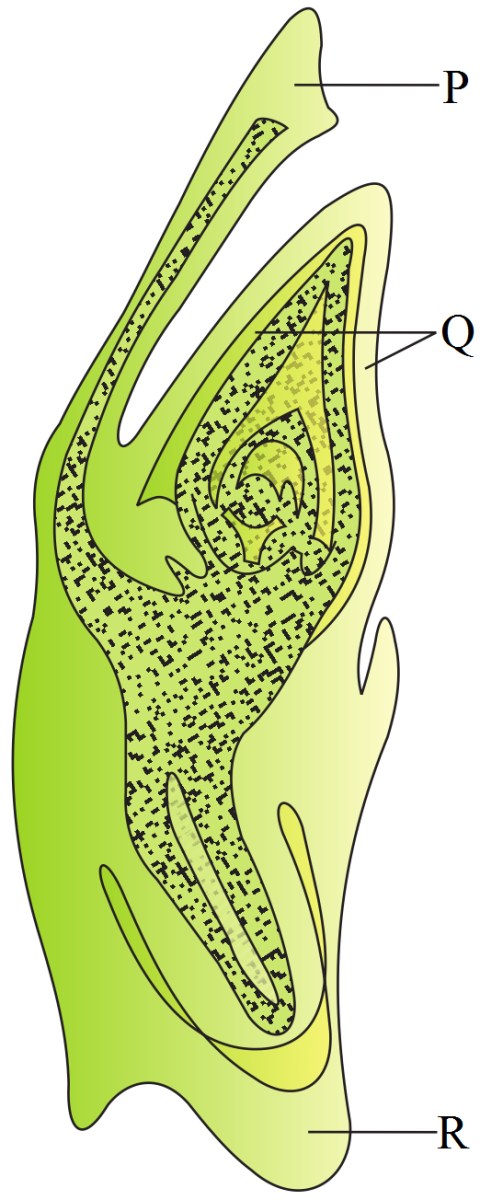
  1. Refer to the given diagram of the embryo of an angiospermous plant with parts labelled P, Q and R. Select the correct statement(s) regarding this.

  1. Part 'P' supplies nutrition to the developing embryo.
  2. Part 'Q' is the protective sheath of radicle and root cap.
  3. Part 'R' is the protective sheath of shoot apex and leaf primordia.
  4. The embryo shown in the diagram is present in members of Family Poaceae.
  1. (IV) only.
  2. (II) and (III) only.
  3. (I) and (IV) only.
  4. (I), (II), (III) and (IV).
  1. Which of the given statements are true?
  1. During the development of a dicot embryo, heart-shaped embryo is followed by globular embryo.
  2. The part of embryonal axis above the level of cotyledons is epicotyl, while the part below the level of cotyledons is hypocotyl.
  3. Monocot seeds possess a single cotyledon, represented by scutellum.
  1. (I) and (II).
  2. (II) and (III).
  3. (I) and (III).
  4. (I), (II) and (III).
  1. Consider the following parts of an embryonal axis of a dicot seed.
  1. Hypocotyl.
  2. Epicotyl.
  3. Radicle.
  4. Plumule.

In which of the following the above parts are correctly arranged from top to base?
  1. (III) → (I) → (II) → (IV).
  2. (II) → (I) → (III) → (IV).
  3. (IV) → (II) → (I) → (III).
  4. (III) → (IV) → (II) → (I).
  1. In grass family, the cotyledon, is called:
  1. Epiblast.
  2. Plumule.
  3. Scutellum.
  4. Perisperm.
Read the following text carefully and answer the questions that follow:
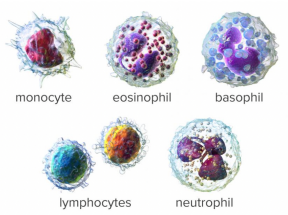
A lymphocyte isa type of white blood cell. Enlarge. Blood cells. Blood contains many types of cells: white blood cells (monocytes, lymphocytes, neutrophils, eosinophils, basophils, and macrophages), red blood cells (erythrocytes), and platelets. Blood circulates through the body in the arteries and veins.
Image
i. Why are the antigens called antibody-generating chemicals? (1)
ii. Which two types of lymphocytes are involved in immunity? (1)
iii. Give the common site of formation of two types of lymphocytes. (2)
OR
What is the site of differentiation of two types of lymphocytes? (2)
Read the following and answer any four questions from (i) to (v) given below:

X and Y are communicable diseases, whereas Wand Z are non-communicable diseases.X is transmitted through vectors whereas Y is transmitted through droplet infection. Wis caused due to a hormone deficiency, whereas Z is a degenerative disease. Based on the above information, answer the following questions.

  1. Identify W, X, Y and Z.
 
W
X
Y
Z
(a)
Coronary artery disease
Cholera
Chikungunya
Chikungunya
(b)
Diabetes
Malaria
Rhinitis
Alzheimer's disease
(c)
Alzheimer's disease
AIDS
Shigella
Plague
(d)
Gonorrhea
Diphtheria
Pertussis
Anthrax
  1. Select the correct statement.
  1. If X is sleeping sickness then its vector is Leishrnania.
  2. If Y is diphtheria then it is caused by Bacillus anthracis.
  3. If W is hypothyroidism then it is caused by deficiency of thyroxine hormone.
  4. If Z is myocardial infarction then patient develops acute rheumatic fever, joint pain and throat infection.
  1. If X and Y both are usual diseases then which of the following holds true?
  1. X could be dengue caused by flavivirus and Y could be AIDS caused by HIV.
  2. X could be chikungunya whereas Y could be rhinitis.
  3. X could be hepatitis whereas Y could be rabies.
  4. X could be chicken pox caused by Va rice/la zoster virus whereas Y could be yellow fever caused by flavivirus
  1. If X and Y both are bacterial diseases then select the correct match from the following.
  1. X- Bubonic plague-Yersinia pestis
  2. Y-Leprosy- Mycobacteriurn leprae
  3. X-Whooping cough-Bordetella pertussis
  4. Y-Botulism-Clostridiurn botulinum
  1. Assertion: Communicable diseases could be contagious or non-contagious.

Reason: Diseases that spread through vectors are non-contagious disease.

  1. Both assertion and reason are true, and reason is the correct explanation of assertion.
  2. Both assertion and reason are true, but reason is not the correct explanation of assertion.
  3. Assertion is true, but reason is false.
  4. Both assertion and reason are false.