MCQ
Nernst equation is, $E = {E^o} - \frac{{RT}}{{nF}}\,\ln Q$ . If $Q = {K_{eq}}$

then which one is not correct

  • A
    $E = 0$
  • B
    $\frac{{RT}}{{nF}}\,\ln {K_{eq}} = {E^o}$
  • $E = {E^o}$
  • D
    ${K_{eq}} = {e^{\frac{{n{E^o}F}}{{RT}}}}$

Answer

Correct option: C.
$E = {E^o}$
c
At equilibrium

$E = 0;{E^o} \ne 0$

Need a full question paper?

Generate a complete, print-ready paper with questions like this in minutes — across 16+ boards, with answer keys.
Start Generating Free

Similar questions

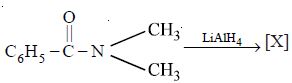
In the given reaction $[X]$ will be :
What is major product of following reaction? $\begin{array}{*{20}{c}}
  {O\,\,\,\,\,\,\,\,\,\,\,\,\,\,\,\,\,\,\,\,\,\,\,\,\,\,\,\,\,\,\,\,\,\,\,\,\,} \\ 
  {||\,\,\,\,\,\,\,\,\,\,\,\,\,\,\,\,\,\,\,\,\,\,\,\,\,\,\,\,\,\,\,\,\,\,\,\,\,\,} \\ 
  {{C_2}{H_5} - C - N{H_2}\xrightarrow[{B{r_2}}]{{KOH}}A\xrightarrow[{KOH}]{{CHC{l_3}}}} 
\end{array}$ Major Product
Glucose forms many derivatives. The derivative which will help to prove the furanose structure is
An organic compound undergoes first order decompostion. The time taken for its decomposition to $\frac{1}{8}$ and $\frac{1}{10}$ of its initial concentration are $t_{1/8}$ and $t_{1/10}$ respectively. What is the value of $\frac{{{t_{1/8}}}}{{{t_{1/10}}}}$ ?   $[\log\, 2 = 0.30]$
In the Claisen-Schmidt reaction to prepare $351 \mathrm{~g}$ of dibenzalacetone using $87 \mathrm{~g}$ of acetone, the amount of benzaldehyde required is . . . . . . .g. (Nearest integer)
In which reaction racemic mixture is not obtained ?
The metals that are employed in the battery industries are

$A$. $\mathrm{Fe}$   $B$. $\mathrm{Mn}$   $C$. $\mathrm{Ni}$   $D$. $\mathrm{Cr}$   $E$. $\mathrm{Cd}$

Choose the correct answer from the options given below:

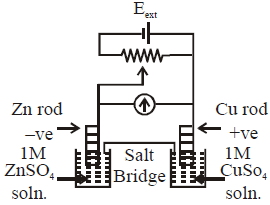
$E _{ Cu ^{2+} \mid Cu }^{\circ}=+0.34 V$

$E _{ Zn ^{2}+\mid Zn }^{ o }=-0.76 V$

Identify the incorrect statement from the options below for the above cell 
The vitamin having metal atom is?
For there action of $H_2$ with $I_2,$ the rate constant is $2.5\times 10^{-4}\,dm^3\,mol^{-1}\,s^{-1}$ at $327\,^oC$ and $1.0\,dm^3\,mol^{-1}\,s^{-1}$ at $527\,^oC$. The activation energy for the reaction, in $kJ\,mol^{-1}$ is: $(R = 8.314\,J\,K^{-1}\,mol^{-1} )$