Question
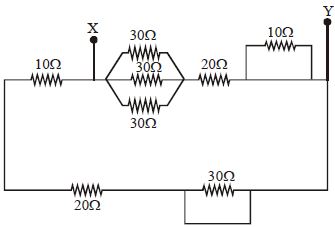
Net resistance between $X$ and $Y$ is ............... $\Omega$

Answer

c
Use series parallel combination

Need a full question paper?

Generate a complete, print-ready paper with questions like this in minutes — across 16+ boards, with answer keys.
Start Generating Free

Similar questions

Image of an object approaching a convex mirror of radius of curvature $20 \mathrm{~m}$ along its optical axis is observed to move from $\frac{25}{3} \mathrm{~m}$ to $\frac{50}{7} \mathrm{~m}$ in 30 seconds. What is the speed of the object in $\mathrm{km}$ per hour?
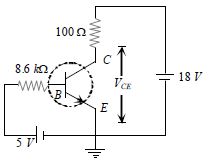
For the transistor circuit shown below, if $\beta = 100,$ voltage drop between emitter and base is $0.7\ V$ then value of  $V_{CE}$ will be.....$V$
In a series LCR circuit, a resistor of $300 \Omega$, a capacitor of 25 nF and an inductor of 100 mH are used. For maximum current in the circuit, the angular frequency of the ac source is $\qquad$ $\times 10^4$ radians $s ^{-1}$.
A $50\,kg$ man with $20\,kg$ load on his head climbs up $20$ steps of $0.25\,m$ height each. The work done in climbing is......$J$
A disc rotating about its axis from rest, acquires the angular speed $100 \,rev/s$ in $4$ second. The angle rotated by it during these four seconds (in radian) is ...... $\pi$
A uniform heating wire of resistance $36\, \Omega$ is connected across a potential difference of $240\, {V}$ The wire is then cut into half and potential difference of $240\, {V}$ is applied across each half separately. The ratio of power dissipation in first case to the total power dissipation in the second case would be $1: {x}$, where ${x}$ is........... .
A particle returns to the starting point after $10\,s$. If the rate of change of velocity during the motion is constant, then its location after $7\,s$ will be same as that after $...........\,s$
A body rotating with uniform angular acceleration covers $100 \pi$ (radian) in the first $5 \,s$ after the start. Its angular speed at the end of $5 \,s$ (in radian/s) is .........$\pi$
For a black body at temperature $727^{\circ} C$, its radiating power is $60\; watt$ and temperature of surrounding is $227^{\circ} C$. If temperature of black body is changed to $1227^{\circ} C$ then its radiating power will be ..... $watt$
A metal rod of cross-sectional area $10^{-4} \,m ^{2}$ is hanging in a chamber kept at $20^{\circ} C$ with a weight attached to its free end. The coefficient of thermal expansion of the rod is $2.5 \times 10^{-6} \,K ^{-1}$ and its Young's modulus is $4 \times 10^{12} \,N / m ^{2}$. When the temperature of the chamber is lowered to $T$, then a weight of $5000 \,N$ needs to be attached to the rod, so that its length is unchanged. Then, $T$ is ............ $^{\circ} C$