MCQ
Neutron possesses
- APositive charge
- BNegative charge
- ✓No charge
- DAll are correct
Generate a complete, print-ready paper with questions like this in minutes — across 16+ boards, with answer keys.
$Br_{2(l)} + Cl_{2(g)} \rightarrow 2BrCl_{(g)}$
are $30\ kJ\ mol^{-1}$ and $105\ J\ K^{-1} mol^{-1}$ respectively. The temperature at which the reaction will be in equilibrium is ............... $\mathrm{K}$
| List$-I$ | List$-II$ |
| $[Image]$ | $(i)$ Wurtz reaction |
| $[Image]$ | $(ii)$ Sandmeyer reaction |
| $(c)$ $2 CH _{3} CH _{2} Cl +2 Na \stackrel{\text { Ether }}{\longrightarrow} C _{2} H _{5}- C _{2} H _{5}+2 NaCl$ | $(iii)$ Fittig reaction |
| $(d)$ $2 C _{6} H _{5} Cl +2 Na \stackrel{\text { Ether }}{\longrightarrow} C _{6} H _{5}- C _{6} H _{5}+2 NaCl$ | $(iv)$ Gatterman reaction |
Choose the correct answer from the options given below: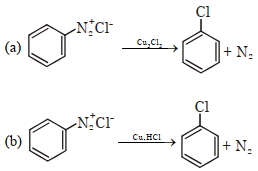
Choose the correct statement($s$).
$(A)$ The order of basicity is $II > I > III > IV$ .
$(B)$ The magnitude of $p K_{ b }$ difference between $I$ and $II$ is more than that between $III$ and $IV$.
$(C)$ Resonance effect is more in $III$ than in $IV$.
$(D)$ Steric effect makes compound $IV$ more basic than $III$.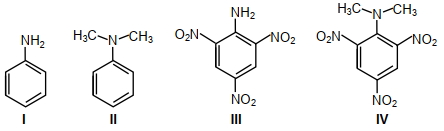
$CH_3 - O - CH(CH_3)_2 + HI \to$ products