MCQ
Newton assumed that sound propagation in a gas takes under
  • Isothermal condition
  • B
    Adiabatic condition
  • C
    Isobaric condition
  • D
    Isentropic condition

Answer

Correct option: A.
Isothermal condition
a
Newton assumed that sound propagation in a gas takes under isothermal condition.

Need a full question paper?

Generate a complete, print-ready paper with questions like this in minutes — across 16+ boards, with answer keys.

Start Generating Free

Similar questions

In order to find time, the astronaut orbiting in an earth satellite should use
A source and an observer are moving towards each other with a speed equal to $\frac{v}{2}$ where $v$ is the speed of sound. The source is emitting sound of frequency $n$. The frequency heard by the observer will be
With respect to a rectangular cartesian coordinate system, three vectors are expressed as

$\vec a = 4\hat i - \hat j$, $\vec b = - 3\hat i + 2\hat j$ and $\vec c = - \hat k$ 

where $\hat i,\,\hat j,\,\hat k$ are unit vectors, along the $X, Y $ and $Z-$axis respectively. The unit vectors $\hat r$ along the direction of sum of these vector is
In uniform circular motion
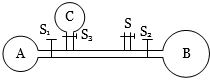
The adjoining diagram shows three soap bubbles $A, B$ and $C$ prepared by blowing the capillary tube fitted with stop cocks, $S_1$, $S_2$ and $S_3$. With stop cock $S$ closed and stop cocks $S_1$, $S_2$ and $S_3$ opened
Stress vs strain curve for the elastic tissue of the aorta, the large tube (vessel) carrying blood from the heart, will be : [stress is proportional to square of the strain for the elastic tissue of the aorta]
Water has maximum density at
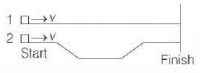
Two small blocks slide without losing contact with the surface along two frictionless tracks $1$ and $2$ , starting at the same time with same initial speed $v$. Track $1$ is perfectly horizontal, while track $2$ has a dip in the middle, as shown in the figure.Which block reaches the finish line first?[Hint: Use velocity-time graph to solve]
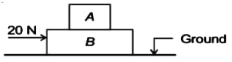
Blocks shown in figure moves with constant velocity $10 \,m / s$ towards right. All surfaces in contact are rough. The friction force applied by $B$ on $A$ is ...........$N$
What is the path followed by a moving body, on which a constant force acts in a direction other than initial velocity (i.e. excluding parallel and antiparallel direction)?