MCQ
$(NH_4 )_2Cr _2O_7$ on heating liberates a gas. The same gas will be obtained by
- ✓Heating $NH_4NO_2$
- BHeating $NH_4NO_3$
- CHeating $(NH_4)_2SO_4$
- DTreating $Mg_3N_2$ with $H _2O$
$NH_4NO_2 \to N_2 + H_2O$
Generate a complete, print-ready paper with questions like this in minutes — across 16+ boards, with answer keys.
$\mathrm{PF}_5, \mathrm{BrF}_5, \mathrm{PCl}_5,\left[\mathrm{PtCl}_4\right]^{2-}, \mathrm{BF}_3, \mathrm{Fe}(\mathrm{CO})_5$
$[Fe(CN)_6]^{4-} \rightarrow [Fe(CN)_6]^{3-} + e^{-1}\, ;$ $ E^o = -0.35\, V$
$Fe^{2+} \rightarrow Fe^{3+} + e^{-1}\ ;$ $E^o = -0.77\, V$
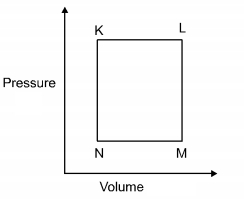
$1.$ The succeeding operations that enable this transformation of states are
$(A)$ Heating, cooling, heating, cooling
$(B)$ Cooling, heating, cooling, heating
$(C)$ Heating, cooling, cooling, heating
$(D)$ Cooling, heating, heating, cooling
$2.$ The pair of isochoric processes among the transormation of states is
$(A)$ $K$ to $L$ and $L$ to $M$
$(B)$ $L$ to $M$ and $N$ to $K$
$(C)$ $L$ to $M$ and $M$ to $N$
$(D)$ $M$ to $N$ and $N$ to $K$
Give the answer question $1$ and $2.$