MCQ
No current flows between two charged bodies connected together when they have the same
  • A
    Capacitance or $\frac{Q}{V}$ ratio
  • B
    Charge
  • C
    Resistance
  • Potential or $\frac{Q}{C}$ ratio

Answer

Correct option: D.
Potential or $\frac{Q}{C}$ ratio
(d) Potential or $\frac{Q}{C}$ ratio

Need a full question paper?

Generate a complete, print-ready paper with questions like this in minutes — across 16+ boards, with answer keys.

Start Generating Free

Similar questions

In Young's double slit experiment, if one of the slit is closed fully, then in the interference pattern
A fringe width of $\,6 mm$ was produced for two slits separated by $1\, mm$ apart. The screen is placed $10\, m$ away. The wavelength of light used is $'x'\, nm.$ The value of $'x'$ to the nearest integer is
The plates of a parallel plate capacitor with no dielectric are connected to a voltage source. Now a dielectric of dielectric constant $K $ is inserted to fill the whole space between the plates with voltage source remaining connected to the capacitor.
Long distance short-wave radio broadcasting uses
For a given material, the energy and wavelength of characteristic X-rays satisfy:
Two charge + q and -q are situated at a certain distance. At the point exactly midway between them
Consider the following statements:

$I$. All isotopes of an element have the same number of neutrons.

$II$. Only one isotope of an element can be stable and non-radioactive.

$III$. All elements have isotopes.

$IV$. All isotopes of carbon can form chemical compounds with oxygen-$16$.

Choose the correct option regarding an isotope.

An ammeter of $100$ $\Omega$ resistance gives full deflection for the current of $10^{-5} \,amp$. Now the shunt resistance required to convert it into ammeter of $1\, amp$. range, will be
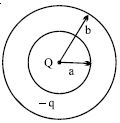
Aspherical shell with an inner radius $'a'$ and an outer radius $'b' $ is made of conducting material. Apoint charge $+Q$ is placed at the centre of the spherical shell and a total charge $- q $ is placed on the shell.

Assume that the electrostatic potential is zero at an infinite distance from the spherical shell. The electrostatic potential at a distance $R$ $(a < R < b)$ from the centre of the shell is (where $K = $ $\frac{1}{{4\pi {\varepsilon _0}}}$)
The resolving power of a telescope can be increased by increasing: