MCQ
Non-polar solvent is
  • A
    Dimethyl sulphoxide
  • Carbon tetrachloride
  • C
    Ammonia
  • D
    Ethyl alcohol

Answer

Correct option: B.
Carbon tetrachloride
b
Due to its symmetrical structure, carbon tetrachloride $\left( CCl _4\right)$ is non - polar. Its non-polar nature makes it a suitable solvent for dissolving non-polar compounds. Carbon tetrachloride is convenient as a solvent for $NMR$ because it contains no protons, however, its poor dissolving power limits its usefulness.

Need a full question paper?

Generate a complete, print-ready paper with questions like this in minutes — across 16+ boards, with answer keys.

Start Generating Free

Similar questions

Which is the weakest base
Given van der Waals constant for $\mathrm{NH}_{3}, \mathrm{H}_{2},\mathrm{O}_{2}$ and $\mathrm{CO}_{2}$ are respectively $4.17,0.244,1.36$ and $3.59,$ which one of the following gases is most easily liquefied?
$A = 1s^2\, 2s^2\, 2p^4$         $B = 1s^2\, 2s^2\, 2p^5$       $C = 1s^2\, 2s^2\, 2p^6$
$A, B$ and $C$ are atoms/anion of same element. Then which one is correct (One of $A/B/C$ is neutral atom)
Which of the following represent pair of enantiomers ?
Reaction of one molecule of $HBr$ with one molecule of $1,3-$butadiene at ${40\,^o}C$ gives predominantly
In which of the following equilibrium, change in volume of the system does not alter the number of moles ?
$1.4\, moles$ of phosphorus trichloride are present in a sample. How many atoms are there in the sample?
Match list $-I$ with list $-II$ and then select the correct answer from the codes given below that list

                                  List $-I$

$(A){\mkern 1mu} {\mkern 1mu} {\mkern 1mu} {C_6}{H_6} + CO + HCl\,\xrightarrow{{AlC{l_3}}}\,{C_6}{H_5}CHO$

$(B){\mkern 1mu} {\mkern 1mu} {\mkern 1mu} {C_6}{H_5} + C{H_3}$ $\xrightarrow{{Cr{O_2}C{l_2}}}\,{C_6}{H_5}CHO$

$(C){\mkern 1mu} {\mkern 1mu} {\mkern 1mu} {C_6}{H_5}C{H_2}Br\, + \,C{H_3}Br$ $\xrightarrow{{Na/ether}}\,{C_6}{H_5}C{H_2}C{H_3}$

$(D){\mkern 1mu} {\mkern 1mu} {\mkern 1mu} {C_6}{H_6}\, + \,{(C{H_3})_2}C = C{H_2}$ $\xrightarrow{{{H_2}S{O_4}}}\,{C_6}{H_5}C{(C{H_3})_3}$

                                 List $-II$
$(a)$   Friedel-Crafts reaction
$(b)$   Wurtz-Fitting reaction
$(c)$   Gattermann-Koch Aldehyde synthesis
$(d)$   Etard’s reaction
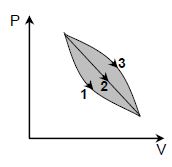
A given mass of gas expands from the state $A$ to the state $B$ by three paths $1, 2$ and $3$ as shown in the figure. If $w_1, w_2$ and $w_3$ respectively be the work done by the gas along three paths then
How many enol form is possible for $\begin{array}{*{20}{c}}
  {O\,\,\,\,\,\,\,\,\,\,\,\,\,\,\,\,\,} \\ 
  {||\,\,\,\,\,\,\,\,\,\,\,\,\,\,\,\,\,} \\ 
  {C{H_3} - C{H_2} - C - C{H_2} - C{H_2} - C{H_3}} 
\end{array}$ (including stereoisomers) will be ?