Question
Nuclear forces are:

Answer

  1. Spin independent and have a non-central part.

Need a full question paper?

Generate a complete, print-ready paper with questions like this in minutes — across 16+ boards, with answer keys.
Start Generating Free

Similar questions

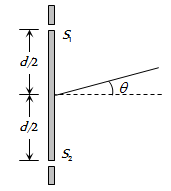
In an interference arrangement similar to Young's double slit experiment, the slits $S_1$ and $S_2$ are illuminated with coherent microwave sources each of frequency $10^6\ Hz$. The sources are synchronized to have zero phase difference. The slits are separated by distance $d = 150 m$. The intensity $I (?)$ is measured as a function of $q,$ where $q$ is defined as shown. If $I_0$ is maximum intensity, then $I(\theta)$ for $0 \leq \theta \leq 90^\circ$ is given by
The energy of a photon of characteristic X-rays from  a Coolidge tube comes from (a) The kinetic energy of the striking electron(b) The kinetic energy of the free electrons of the target(c) The kinetic energy of the ions of the target(d) An electronic transition of the target atom


A short magnet of moment $6.75 \mathrm{Am}^2$ produces a neutral point on its axis. If horizontal component of earth's magnetic field is $5 \times 10^{-5} \mathrm{wb} / \mathrm{m}^2$, then the distance of the neutral point should be
A parallel combination of two capacitors of capacitance $C_1$ and $C_2$ is given a charge $Q$. If there is $Q_1$ charge on $C_1$ and $Q_2$ charge on $C_2$, the ratio of $\frac{Q_1}{Q_2}$ will be:
Insulation breakdown may occur at _______?
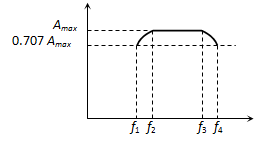
The frequency response curve of $RC$ coupled amplifier is shown in figure. The band width of the amplifier will be
In a photoelectron experiment, the stopping potential from the photoelectrons is 2V for the incident of wavelength 400nm. If the incident light is changed to 300nm, the cut-off potential is:
What happens when some charge is placed on a soap bubble?
The plates of a capacitor are charged to a potential difference of 320 volts and are then connected across a resistor. The potential difference across the capacitor decays exponentially with time. After 1 second  the potential difference between the plates of the capacitor is 240 volts, then after 2 and 3 seconds the potential difference between the plates will be(a) 200 and 180 V(b) 180 and 135 V(c) 160 and 80 V(d) 140 and 20 V
       
Energy released in fusion of $1 \ kg$ of deuterium nuclei