MCQ
Nuclear forces exists between:
  • A
    Neutron $-$ neutron.
  • B
    Proton $-$ proton.
  • C
    Neutron $-$ proton.
  • All of these.

Answer

Correct option: D.
All of these.

Need a full question paper?

Generate a complete, print-ready paper with questions like this in minutes — across 16+ boards, with answer keys.

Start Generating Free

Similar questions

A condenser having a capacity of $6\,\mu F$ is charged to $100\, V$ and is then joined to an uncharged condenser of $14\,\mu F$ and then removed. The ratio of the charges on $6\,\mu F$ and $14\,\mu F$ and the potential of $6\,\mu F$ will be
A metal conductor of length $1\;m$ rotates vertically about one of its ends at angular velocity $5$ radians per second. If the horizontal component of earth's magnetic field is $0.2 \times {10^{ - 4}}\;T$, then the $e.m.f$. developed between the two ends of the conductor is
The increasing order of atomic radii of the following Group $13$ elements is
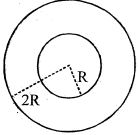
Consider the shown system of two concentric thin metal shells. The inner hell has charge $Q$, while the outer shell is neutral. Potential difference between the shells is $V$. If the shell are joined by metal wire, then potential of the inner shell is
In order to increase the capacity of a parallel plate condenser, one should introduce a sheet of between the plates $($assume that the space is completely filled$).$
An α- particle travels in a circular path of radius 0.45 m in a magnetic field B = 1.2 Wb/m$^2$ with a speed of $2.6\times 10^7$ m/sec. The period of revolution of the α - particle is
If the turns ratio of a transformer is $2$ and the impedance of primary coil is $250 \ W$ then the impedance of secondary coil will be.
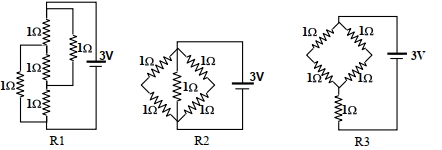
Figure shows three resistor configurations $\mathrm{R} 1, \mathrm{R} 2$ and $\mathrm{R} 3$ connected to $3 \mathrm{~V}$ battery. If the power dissipated by the configuration $\mathrm{R} 1, \mathrm{R} 2$ and $\mathrm{R} 3$ is $\mathrm{P} 1, \mathrm{P} 2$ and $\mathrm{P} 3$, respectively, then

Figure:

$^{22}Ne$ nucleus after absorbing energy decays into two $\alpha - $ particles and an unknown nucleus. The unknown nucleus is
Which of the following is the fusion reaction