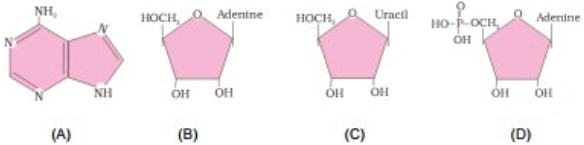
MCQ
Nucleoside is:
  • A
    $A$ and $B$
  • $B$ and $C$
  • C
    $C$ and $D$
  • D
    $D$ and $A$

Answer

Correct option: B.
$B$ and $C$
b
The correct option is $(B).$

Need a full question paper?

Generate a complete, print-ready paper with questions like this in minutes — across 16+ boards, with answer keys.

Start Generating Free

Similar questions

Which one of the following is common to multicellular fungi, filamentous algae and protonema of moses
Three morphological forms of golgi complex are
Name the scientist, who demonstrated by belljar experiment that plants purified the air.
Read the following five statements $(A-E)$ and answer as asked next to them.

$(A)$ In Equisetum, the female gametophyte is retained on the parent sporophyte.

$(B)$ In Ginkgo, male gametophyte is not independent.

$(C)$ The sporophyte in Riccia is more developed than that in Polytrichum.

$(D)$ Sexual reproduction in Volvox is isogamous.

$(E)$ The spores of slime moulds lack cell walls.How many of the above statements are correct?

Extraction and separation of chlorophylls and carotenoids tackles by
Energy enters in ecosystem through
In anaerobic respiration, from one glucose molecule how many net $ATP$ molecules are formed
Which characters for Phyllotaxy are incorrect from given characters ?
(i) Phyllotaxy is the pattern of arrangement of leaves on the stem or branch.
(ii) In alternate phyllotaxy, a single leaf arises at each node in alternate manner.
(iii) Alternate phyllotaxy present in Calotropis and guava plants.
(iv) In opposite phyllotaxy, a pair of leaves arise at each node and lie opposite to each other.
(v) Opposite phyllotaxy present in china rose, mustard and sun flower plants.
(vi) Whorled phyllotaxy present in Alstonia.
Pinus seed cannot germinate and establish without fungal association. This is because
Match the columns.

 $\begin{array}{|l|l|} \hline Column\,\,-I  & Column\,\,-II  \\ \hline (a)\,\,4\,\,C\,\,compound & (1)\,\,Acetyl\,\,Co\,\,A  \\ \hline (b)\,\,2\,\,C\,\,compound & (2)\,\,Pyruvate  \\ \hline (c)\,\,5\,\,C\,\,compound & (3)\,\,Citric\,\,acid  \\ \hline (d)\,\,3\,\,C\,\,compound & (4)\,\,\alpha\,\,-\,\,Ketoglutatic\,\,acid \\ \hline  & (5)\,\,Malic\,\,acid  \\ \hline \end{array}$