MCQ
Number of orbitats in $h$ sub-shell is
  • $11$
  • B
    $15$
  • C
    $17$
  • D
    $19$

Answer

Correct option: A.
$11$
a
(a)  $s$    $p$    $d$    $f$    $g$    $h$

     $l$ = $0$    $1$    $2$    $3$    $4$    $5$

Number of orbitals $ = 5 \times 2 + 1 = 11$

Need a full question paper?

Generate a complete, print-ready paper with questions like this in minutes — across 16+ boards, with answer keys.

Start Generating Free

Similar questions

The values of $\Delta H$ and $\Delta S$ for the reaction,

$C_{(graphite)} + CO_{2(g)} \rightarrow 2CO _{(g)}$

are $170\, kJ$ and $170\, J K^{-1},$ respectively. This reaction will be spontaneous at ............ $\mathrm{K}$

For the reaction system $2NO(g) + {O_2}(g) \to 2N{O_2}(g)$ volume is suddenly produced to half its value by increasing the pressure on it. If the reaction is of first order with respect to $O_2$ and second order with respect to $NO,$ the rate of reaction will
The element of ${s^2}{p^2}$ configuration is of ..... group
Cresols are
The ionic bonds $X^+Y^-$ are formed when

$(I)$ electron affinity of $Y$ is high    $(II)$ ionization energy of $X$ is low

$(III)$ lattice energy of $XY$ is high   $(IV)$ lattice energy of $XY$ is low

Choose the correct code
$\begin{array}{*{20}{c}}
  {\begin{array}{*{20}{c}}
  {\,\,\,\,\,\,\,\,C{H_3}\,\,} \\ 
  |\,\,\, 
\end{array}\,\,\,\,\,\,\,\,\,} \\ 
  {C{H_3} - C - O - C{H_3}} \\ 
  {|\,\,\,\,\,\,\,\,\,\,\,\,} \\ 
  {\,C{H_3}\,\,\,\,} 
\end{array}$ $\xrightarrow[{(cold)}]{{HI}}$ Product is
Generally, a group of atoms can function as a ligand if
Although no currently known element contains electrons in $g$ orbitals in the ground state, it is possible that such element will be found or that electrons in excited states of known elements could be in $g$ orbitals. For $g$ orbitals, $1 = 4.$ What is the lowest value of $n$ for which $g$ orbitals could exist ? What are the possible values of $m$ ? How many electrons could a set of $g$ orbitals hold ?
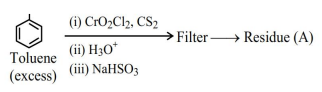
Image
Residue (A) + HCl (dil.) $\rightarrow$ Compound (B)
Structure of residue (A) and compound (B)
Formed respectively is :
The main product of following raction will be
