MCQ
Number of spectral lines in hydrogen atom is
  • A
    $3$
  • B
    $6$
  • C
    $15$
  • Infinite

Answer

Correct option: D.
Infinite
d
(d) Infinitely large transitions are possible (in principle) for the hydrogen atom.

Need a full question paper?

Generate a complete, print-ready paper with questions like this in minutes — across 16+ boards, with answer keys.
Start Generating Free

Similar questions

A radioactive material undergoes decay by ejecting electrons. The electron ejected in this process is:
The magnetic flux through a coil perpendicular to its plane is varying according to the relation $\phi=$ $\left(5 t^{3}+4 t+2 t-5\right) \; Weber$. If the resistant of the coil is $5 \; ohm$, then the induced current through the coil at $t =2 \; sec$ will be $....\,A$
If we need a magnification of $375$ from a compound microscope of tube length $150\; \mathrm{mm}$ and an objective of focal length $5\; \mathrm{mm}$, the focal length of the eye-piece, should be close to.....$mm$
A coil has an inductance of 2.5 H and a resistance of 0.5 r. If the coil is suddenly connected across a 6.0 volt battery, then the time required for the current to rise 0.63 of its final value is
By Huygen's wave theory of light, we cannot explain the phenomenon of
$f_v$ and $f_r$ are the focal lengths of a convex lens for violet and red light respectively and $F_v$ and $F_r$ are the focal lengths of a concave lens for violet and red light respectively, then
Magnitude of current at half power point in a circuit is:
The number of protons in an atom of atomic number $Z$ and mass number $A$ is:
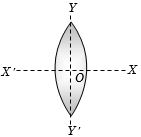
An equiconvex lens is cut into two halves along $(i) XOX'$ and $(ii) YOY'$ as shown in the figure. Let $f, f ', f "$ be the focal lengths of the complete lens, of each half in case $(i),$ and of each half in case $(ii),$ respectively Choose the correct statement from the following
According to Bohr's model, the radius of the second orbit of helium atom is........$\mathop A\limits^o $