MCQ
Number of visible lines in Balmer's series
  • A
    $2$
  • $4$
  • C
    $3$
  • D
    $5$

Answer

Correct option: B.
$4$
b
The first four lines are only in the visible region. The $5^{\text {th }}$ line
goes into the ultraviolet region.

Need a full question paper?

Generate a complete, print-ready paper with questions like this in minutes — across 16+ boards, with answer keys.
Start Generating Free

Similar questions

A thin rod is bent in the shape of a small circle of radius $'r'$. If the charge per unit length of the rod is $'\sigma ',$ and if the circle is rotated about its axis at the rate of $'n'$ rotation per second, the magnetic induction at a point on the axis at a large distance $'y'$ from the centre is
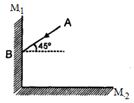
The mirrors are perpendicular to each other as shown in fig. A light ray $A B$ is incident on the mirror $M _1$. Then the reflected ray will also suffer a reflection from the mirror $M _2$. Then the final ray after reflection from $M _2$ will be parallel to the incident ray, if
In a toroid the number of turns per unit length is $1000$ and current through it is $\frac{1}{4 \pi}$ ampere. The magnetic field produced inside (in $weber / m ^2$ ) will be
A hollow metallic sphere of radius $10 \;cm$ is charged such that potential of its surface is $80\; V$. The potential at the centre of the sphere would be
Light transmitted by nicol prism is:
Needles $N_I,  N_2$ and $N_3$ are made of a ferromagnetic, a paramagnetic and a diamagnetic substance respectively. A magnet when brought close to them will
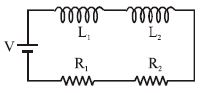
Given $L_1 = 1\, mH, R_1 = 1\,\Omega , L_2 = 2\,mH, R_2 = 2\,\Omega $ Neglecting mutual inductance the time constants (in $ms$) for circuit.....$ms$
A thin cylindrical rod of length $10\,cm$ is placed horizontally on the principle axis of a concave mirror of focal length $20\,cm$. The rod is placed in a such a way that mid point of the rod is at $40\,cm$ from the pole of mirror. The length of the image formed by the mirror will be $\frac{x}{3} cm$. The value of $x$ is $............$.
A uniform spherical shell gradually shrinks maintaining its shape. The gravitational potential at the centre:
A moving coil galvanometer has a resistance of 50 Ω and gives full scale deflection for 10 mA. How could it be converted into an ammeter with a full scale deflection for 1A.