MCQ
Number of waves formed by a Bohr electron in one complete revolution in its third orbit is
  • A
    $0$
  • B
    $1$
  • C
    $2$
  • $3$

Answer

Correct option: D.
$3$
d
Angular momentum of $n^{t h}$ bohr orbit $=\frac{n h}{2 \lambda}$

$m \cdot v \cdot r_{n}=\frac{n h}{2 \lambda}$

$m v=\frac{h}{\lambda}$ (according to de Broglie)

$\left(\frac{h}{\lambda}\right) r_{n}=\frac{n h}{2 \lambda}$

$n \lambda=2 \pi r_{n}(n=3)$

$2 \lambda=2 \pi r_{n}$

these the circumference of $3^{r d}$ Bohr orbit equal to 3 terms the wavelength of an electron makes this revolution around the $3^{r d}$ orbit

Hence no. of the wave $=3$

Hence, the correct option is $\mathrm{D}$

Need a full question paper?

Generate a complete, print-ready paper with questions like this in minutes — across 16+ boards, with answer keys.
Start Generating Free

Similar questions

The major product for in the reaction
The $IUPAC$ name of $\begin{matrix}
   \,\,\,\,\,\,\,\,\,\,\,\,\,\,\,\,\,\,\,\,\,\,\,\,\,\,\,\,\,\,\,\,\,\,\,\,\,\,\,\,\,\,\,\,\,\,\,\,\,\,\,\,\,\,\,\,\,C{{H}_{3}}\,  \\
   \,\,\,\,\,\,\,\,\,\,\,\,\,\,\,\,\,\,\,\,\,\,\,\,\,\,\,\,\,\,\,\,\,\,\,\,\,\,\,\,\,\,\,\,\,\,\,\,\,\,|  \\
   C{{H}_{3}}-C{{H}_{2}}-CH-CH-C-C{{H}_{3}}  \\
   \,\,\,\,\,\,\,\,\,\,\,\,\,\,\,\,\,\,\,\,\,|\,\,\,\,\,\,\,\,\,\,\,\,\,|\,\,\,\,\,\,\,\,\,\,\,\,|\,  \\
   \,\,\,\,\,\,\,\,\,\,\,\,\,\,\,\,\,\,\,\,\,\,\,Cl\,\,\,\,\,\,\,\,C{{H}_{3}}\,\,\,OH  \\
\end{matrix}$ is
Acetic acid, $(CH_3COOH),$ has a $PK_a$ of $4.8.$ Ethanol, $(CH_3CH_2OH)$, has a $pK_a$ of $16.0.$ What are the major species present,  when acetic acid and ethanol are added to water and the $pH$ is adjusted to $7.0$ ?
In a chemical reaction $A + 2B \overset K  \rightleftharpoons  2C + D$, the initial concentration of $B$ was $1.5$ times of $A$ but the equilibrium concentrations of $A$ and $B$ were found to be equal. The equilibrium, constant $(K)$ for the aforesaid chemical reaction is
On complete combustion of $0.492\,g$ of an organic compound containing $C , H$ and $O , 0.7938\,g$ of $CO _{2}$ and $0.4428\,g$ of $H _{2} O$ was produced. The $\%$ composition of oxygen in the compound is $........$
Decreasing order of stability :
In the following reaction

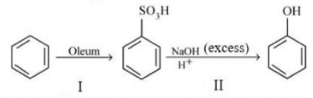
The $\%$ yield for reaction $I$ is $60 \%$ and that of reaction II is $50 \%$. The overall yield of the complete reaction is $..........\%$ [nearest integer]
The following compounds do not show ketoenol tautomerism, except:
Successive members of homologous series differ from one another in their mass by:
What is the $pH$ value of $M\, H_2SO_4$ ?