Question
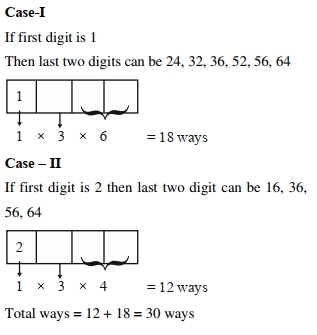
Numbers are to be formed between $1000$ and $3000$, which are divisible by $4$, using the digits $1,2,3,4,5$ and $6$ without repetition of digits. Then the total number of such numbers is.
Answer

b

Need a full question paper?

Generate a complete, print-ready paper with questions like this in minutes — across 16+ boards, with answer keys.

Start Generating Free

Similar questions

If $a,b$ and $c$ are perpendicular to $b + c,c + a$and $a + b$ respectively and if $|a + b| = 6,|b + c| = 8$ and $|c + a| = 10$ then $|a + b + c| = $
Let $[\alpha]$ denote the greatest integer $\leq \alpha$. Then $[\sqrt{1}]+[\sqrt{2}]+[\sqrt{3}]+\ldots .+[\sqrt{120}]$ is equal to.
If $1^2 + 2^2 + 3^2 + ...... +2009^2 = (2009)(335)(4019)$ and $(1)(2009) + 2(2008) + 3(2007) + ....... + 2009(1) = (2009)(335)(x)$, then $x$ equal to :-
The number of solutions of $|sin^{-1}x|$ = $|x|$ is
Let $f: R \rightarrow R$ be defined $f(x)=a e^{2 x}+b e^x+c x$. If $f(0)=-1, f^{\prime}\left(\log _e 2\right)=21$ and $\int_0^{\log _e 4}(f(x)-c x) d x=\frac{39}{2}$, then the value of $|a+b+c|$ equals:
The sum of all two digit positive numbers which when divided by $7$ yield $2$ or $5$ as remainder is
The mean and variance of $10$ observations were calculated as $15$ and $15$ respectively by a student who took by mistake $25$ instead of $15$ for one observation. Then, the correct standard deviation is$.....$
The value of $\frac{8}{\pi} \int \limits_0^{\frac{\pi}{2}} \frac{(\cos x)^{2023}}{(\sin x)^{2023}+(\cos x)^{2023}} d x$ is $.............$.
Let $\mathrm{E}_{1}: \frac{\mathrm{x}^{2}}{9}+\frac{\mathrm{y}^{2}}{4}=1$ be an ellipse. Ellipses $\mathrm{E}_{\mathrm{i}}^{\prime}$ 's are constructed such that their centres and eccentricities are same as that of $E_{1}$, and the length of minor axis of $\mathrm{E}_{\mathrm{i}}$ is the length of major axis of $E_{i+1}(i \geq 1)$. If $A_{i}$ is the area of the ellipse $E_{i}$, then $\frac{5}{\pi}\left(\sum_{i=1}^{\infty} \mathrm{A}_{\mathrm{i}}\right)$, is equal to $\qquad$
If the range of $f(\theta)=\frac{\sin ^4 \theta+3 \cos ^2 \theta}{\sin ^4 \theta+\cos ^2 \theta}, \theta \in R$ is $(\alpha, \beta)$, then the sum of the infinite $G.P.,$ whose first term is $64$ and the common ratio is $\frac{\alpha}{\beta}$, is equal to $.........$