MCQ
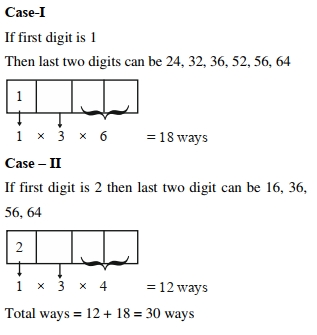
Numbers are to be formed between $1000$ and $3000$, which are divisible by $4$, using the digits $1,2,3,4,5$ and $6$ without repetition of digits. Then the total number of such numbers is.
  • A
    $3$
  • $30$
  • C
    $60$
  • D
    $15$

Answer

Correct option: B.
$30$
b

Need a full question paper?

Generate a complete, print-ready paper with questions like this in minutes — across 16+ boards, with answer keys.

Start Generating Free

Similar questions

A bag contains 5 brown and 4 white socks. Ram pulls out two socks. What is the probability that both the socks are of the same colour?
In a game, a man wins $Rs.\,100$  if he gets $5$ or $6$ on a throw of a fair die and loses $Rs.\,50$ for getting any other number on the die. If he decides to throw the die either till he gets a five or a six or to a maximum of three throws, then his expected gain/loss (in rupees) is
If the algebraic sum of deviations of $20$ observations from $30$ is $20$, then the mean of observations is
If the set $R=\{(a, b) ; a+5 b=42, a, b \in \mathbb{N}\}$ has $m$ elements and $\sum_{n=1}^m\left(1+i^{n !}\right)=x+i y$, where $I=\sqrt{-1}$, then the value of $m+x+y$ is :
The length of the latus rectum of the parabola whose focus is (3, 3) and directrix is 3x - 4y - 2 = 0 is
If $x_1 , x_2 ,  ..... , x_n$ and $\frac{1}{{{h_1}}},\frac{1}{{{h^2}}},......\frac{1}{{{h_n}}}$ are two $A.P' s$ such that $x_3 = h_2 = 8$ and $x_8 = h_7 = 20$, then $x_5. h_{10}$ equals
0 + 0 i is ______________________for complex number z.
The set of all values of $a^2$ for which the line $x + y =0$ bisects two distinct chords drawn from a point $P\left(\frac{1+a}{2}, \frac{1-a}{2}\right)$ on the circle $2 x ^2+2 y ^2-(1+ a ) x -(1- a ) y =0$ is equal to:
The sum $ \displaystyle \sum _{\text{ r}=1 }^{ 10 }{ \left( {\text{ r} }^{ 2 }+1 \right) \times \left( \text{r}\ ! \right) }$ is equal to:
If the sum of the first $15$ terms of the series ${\left( {\frac{3}{4}} \right)^3} + {\left( {1\frac{1}{2}} \right)^3} + {\left( {2\frac{1}{4}} \right)^3} + {3^3} + {\left( {3\frac{3}{4}} \right)^3} + .....$ is equal to $225\,k,$ then $k$ is equal to