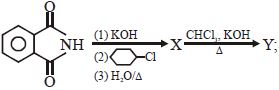
MCQ
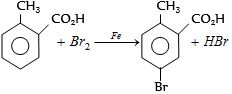
$o-$ Toluic acid on reaction with $B{r_2} + Fe$ gives
- A

- B
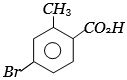
- ✓

- D

Generate a complete, print-ready paper with questions like this in minutes — across 16+ boards, with answer keys.
$(A)$ Graphite is harder than diamond.
$(B)$ Graphite has higher electrical conductivity than diamond
$(C)$ Graphite has higher thermal conductivity than diamond
$(D)$ Graphite has higher $C$ - $C$ bond order than diamond
$(I)$ It is easier to remove $2 \mathrm{p}$ electron than $2 \mathrm{s}$ electron
$(II)$ $2 \mathrm{p}$ electron of $\mathrm{B}$ is more shielded from the nucleus by the inner core of electrons than the $2 s$ electrons of $Be.$
$(III)\; 2 s$ electron has more penetration power than $2 \mathrm{p}$ electron.
$(IV)$ atomic radius of $\mathrm{B}$ is more than $\mathrm{Be}$
(Atomic number $\mathrm{B}=5, \mathrm{Be}=4$ )
The correct statements are
| List$-I$ | List$-II$ |
| $(I)$ Radius of the $n^{\text {th }}$ orbit | $(P)$ $\propto n ^{-2}$ |
| $(II)$ Angular momentum of the electron in the $n^{\text {th }}$ orbit | $(Q)$ $\propto n ^{-1}$ |
| $(III)$ Kinetic energy of the electron in the $n^{\text {th }}$ orbit | $(R)$ $\propto n ^0$ |
| $(IV)$ Potential energy of the electron in the $n^{\text {th }}$ orbit | $(S)$ $\propto n ^1$ |
| $(T)$ $\propto n ^2$ | |
| $(U)$ $\propto n ^{1 / 2}$ |