Question
$OABC$ is a current carrying square loop an electron is projected from the centre of loop along its diagonal $AC$ as shown. Unit vector in the direction of initial acceleration will be
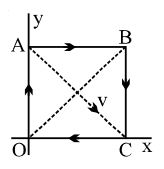
Force will be along $B O$ or unit vector
$=-\frac{\hat{i}+\hat{j}}{\sqrt{2} a}$
Generate a complete, print-ready paper with questions like this in minutes — across 16+ boards, with answer keys.
[$A$] At minimum deviation, the incident angle $i_1$ and the refracting angle $r_1$ at the first refracting surface are related by $\mathrm{r}_1=\left(\mathrm{i}_1 / 2\right)$.
[$B$] For this prism the refractive index $\mu$ and the angle of prism $A$ are related as $A=\frac{1}{2} \cos ^{-1}(\mu / 2)$.
[$C$] For this prism, the emergent ray at the second surface will be tangential to the surface when the angle of incidence at the first surface is $i_1=\sin ^{-1}\left[\sin A \sqrt{4 \cos ^2 \frac{A}{2}-1}-\cos A\right]$.
[$D$] For the angle of incidence $i_1=A$, the ray inside the prism is parallel to the base of the prism.
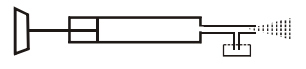
$1.$ If the piston is pushed at a speed of $5 \ mms ^{-1}$, the air comes out of the nozzle with a speed of
$(A)$ $0.1 \ ms ^{-1}$ $(B)$ $1 \ ms ^{-1}$ $(C)$ $2 \ ms ^{-1}$ $(D)$ $8 \ ms ^{-1}$
$2.$ If the density of air is $\rho_{ a }$ and that of the liquid $\rho_{\ell}$, then for a given piston speed the rate (volume per unit time) at which the liquid is sprayed will be proportional to
$(A)$ $\sqrt{\frac{\rho_{ a }}{\rho_{\ell}}}$ $(B)$ $\sqrt{\rho_a \rho_{\ell}}$ $(C)$ $\sqrt{\frac{\rho_{\ell}}{\rho_{ a }}}$ $(D)$ $\rho_{\ell}$
Give the answer question $1$ and $2.$