MCQ
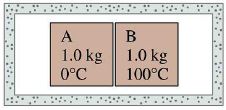
Objects $A$ and $B$ that are initially separated from each other and well isolated from their surroundings are then brought into thermal contact. Initially $T_A= 0^oC$ and $T_B = 100^oC$. The specific heat of $A$ is less than the specific heat of $B$. After some time, the system comes to an equilibrium state. The final temperatures are :
  • $T_A= T_B > 50^°C$
  • B
    $T_A> T_B > 50^°C$
  • C
    $T_A= T_B < 50^°C$
  • D
    $T_B > T_A> 50^°C$

Answer

Correct option: A.
$T_A= T_B > 50^°C$
a
At equlibrium temp. of both objects are same Heat loss $+$ heat gain $= 00$
$M_BC_B (T -100) + M_AC_A (T -0) = 0$

Need a full question paper?

Generate a complete, print-ready paper with questions like this in minutes — across 16+ boards, with answer keys.

Start Generating Free

Similar questions

Figure shows the position of a particle moving on the $x$-axis as a function of time
In a screw gauge, there are $100$ divisions on the circular scale and the main scale moves by $0.5\,mm$ on a complete rotation of the circular scale. The zero of circular scale lies $6$ divisions below the line of graduation when two studs are brought in contact with each other. When a wire is placed between the studs, $4$ linear scale divisions are clearly visible while $46^{\text {th }}$ division the circular scale coincide with the reference line. The diameter of the wire is $...........\times 10^{-2}\,mm$
Obtain the dimensional equation for universal gas constant.
A closed cylindrical vessel contains $N$ moles of an ideal diatomic gas at a temperature $T$. On supplying heat, temperature remains same, but $n$ moles get dissociated into atoms. The heat supplied is .........
A gaseous mixture consists of 16g of helium and 16g of oxygen. The ratio CP/ CV of the mixture is:
Two springs A and B(kA = 2kB) are stretched by applying forces of equal magnitudes at the four ends. If the energy stored in A is E, that in B is:
A particle is projected with a velocity of $30\,m / s$, at an angle of $\theta_0=\tan ^{-1}\left(\frac{3}{4}\right)$ After $1\,s$, the particle is moving at an angle $\theta$ to the horizontal, where $\tan \theta$ will be equal to $\left(g=10\,m / s ^2\right)$
A disc of radius $1\,m$ and mass $4\,kg$ rolls on a horizontal plane without slipping in such a way that its centre of mass moves with a speed of $10\,cm/\sec .$ Its rotational kinetic energy is
In the relation $y = a\cos (\omega t - kx)$, the dimensional formula for $k$ is
A student plots a graph from his reading on the determination of Young modulus of a metal wire but forgets to put the labels. the quantities on X and Y axes may be respectively:
  1. Weight hung and length increased.
  2. Stress applied and length Increased.
  3. Stress applied and strain developed.
  4. Length increased and the weight hung.
​​​​​​​