Question
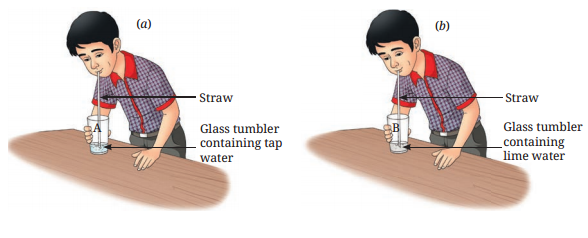
✓
Answer
Observation and conclusion: When we blow air (carbon dioxide) from mouth to tumbler A containing water, we do not observe any change in the colour of water. But when we blow air into tumbler B containing lime water (calcium hydroxide), lime water turns milky and white-coloured insoluble substance (calcium carbonate) gets settle down. Thus, this is classified as chemical change as new substance is being formed.
$\begin{array}{l}\text { Carbon dioxide }\end{array}+\underset{\text { (calcium hydroxide) }}{\text { Lime water }} \rightarrow \underset{\text { carbonate (milky) }}{\text { Calcium }}+ \text { water }$
$\begin{array}{l}\text { Carbon dioxide }\end{array}+\underset{\text { (calcium hydroxide) }}{\text { Lime water }} \rightarrow \underset{\text { carbonate (milky) }}{\text { Calcium }}+ \text { water }$
Need a full question paper?
Generate a complete, print-ready paper with questions like this in minutes — across 16+ boards, with answer keys.
Explore more
Similar questions
A student is asked to focus sunlight using two different lenses onto a paper.
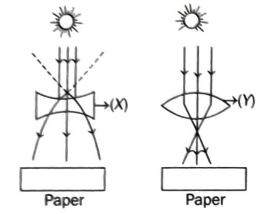
Observe the image carefully and answer the following questions.
(i) State the name for the shape of lenses X and Y.
(ii) Which of these two lenses can be used to magnify images?
(iii) Explain the changes that happen to the paper kept under both the lenses.
Observe the image carefully and answer the following questions.
(i) State the name for the shape of lenses X and Y.
(ii) Which of these two lenses can be used to magnify images?
(iii) Explain the changes that happen to the paper kept under both the lenses.
Solve the crossword given as Figure.
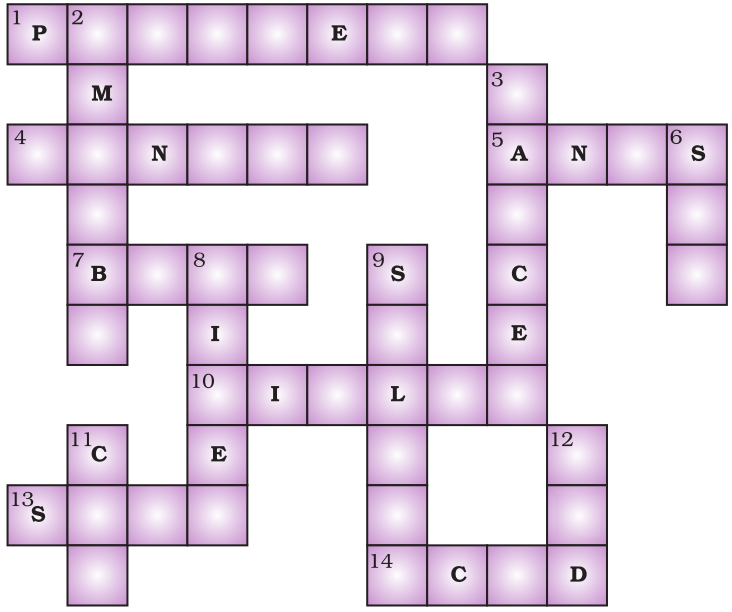
Across:
Across:
- Cream-coloured digestive gland
- Undigested excretory solid residues
- Organ that mixes saliva with the food
- Point of defecation
- Stored in gall bladder
- Finger-like outgrowth in the small intestine
- Kind of taste buds
- Kills bacteria in the stomach
- Feeds with the help of pseudopodia
- Total number of molars in one jaw of an adult
- Largest gland
- Watery secretion in the mouth
- A ruminant
- Form of food chewed by ruminants
Briefly describes the human circulatory system?
Distinguish between the following. Blood and Plasma.
Name the source from which litmus solution is obtained. What is the use of this solution?
“A bunch of seedlings were seen sprouting on a heap of animal dropping in a forest.” How do you think is the seedling benefited from the animal dung?
A person met with an accident while driving. After examination, the doctor told him that since he got a fracture in the wrist, operation would be required. After the operation, the patient was put on a glucose drip and was not given food for a few hours.
(i) Why was the patient not given food directly?
(ii) How does the glucose help the patient recover?
(i) Why was the patient not given food directly?
(ii) How does the glucose help the patient recover?
Explain the function of bar screens in a wastewater treatment plant.
Read the passage and answer the questions :
You are conducting an experiment where you add vinegar to baking soda. As soon as the two substances mix, there is a fizzing sound, and bubbles of gas begin to form, pass this gas through freshly prepared lime water. You observe that the lime water has turned milky due to formation of a precipitate.
Q.1. What type of change has occurred in this experiment?
(a) Physical change
(b) Chemical change
(c) Both physical and chemical change
(d) No change
Q.2. What is the gas that has been produced in this reaction?
(a) Oxygen$\quad$(b) Nitrogen
(c) Carbon dioxide$\quad$(d) Hydrogen
Q.3. What is the name of the white precipitate that forms in the solution?
(a) Calcium hydroxide
(b) Calcium carbonate
(c) Sodium bicarbonate
(d) Magnesium oxide
→You are conducting an experiment where you add vinegar to baking soda. As soon as the two substances mix, there is a fizzing sound, and bubbles of gas begin to form, pass this gas through freshly prepared lime water. You observe that the lime water has turned milky due to formation of a precipitate.
Q.1. What type of change has occurred in this experiment?
(a) Physical change
(b) Chemical change
(c) Both physical and chemical change
(d) No change
Q.2. What is the gas that has been produced in this reaction?
(a) Oxygen$\quad$(b) Nitrogen
(c) Carbon dioxide$\quad$(d) Hydrogen
Q.3. What is the name of the white precipitate that forms in the solution?
(a) Calcium hydroxide
(b) Calcium carbonate
(c) Sodium bicarbonate
(d) Magnesium oxide
In a health awareness seminar, students learned that smoking affects the lungs by damaging the alveoli and reducing their surface area. This makes breathing difficult and reduces the amount of oxygen absorbed into the blood.
(i) Which part of the lungs gets damaged by smoking?
(ii) What happens when the alveoli are damaged?
(iii) Why is smoking dangerous for health?
(i) Which part of the lungs gets damaged by smoking?
(ii) What happens when the alveoli are damaged?
(iii) Why is smoking dangerous for health?