Question
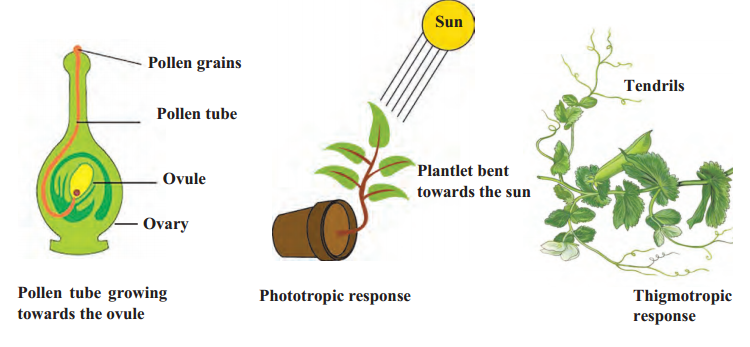
Observe the following figures carefully.

Image

Answer

Observations:
  • Figure ‘A’ shows chemotropic movement. Pollen tube grows towards the ovule in response to specific chemicals released by the ovule.
  • Figure ‘B’ shows phototropic movement. Shoot grows towards the Sun in response to stimulus of light.
  • Figure ‘C’ shows thigmotropic movement. Tendrils of climbers are sensitive to touth. When they come in contact with an object, they entwine around the object and cling to it.
  • All the above movements are related to growth. Hence, they are called growth relevant movements.

Need a full question paper?

Generate a complete, print-ready paper with questions like this in minutes — across 16+ boards, with answer keys.
Start Generating Free

Similar questions

A sweets shop looks attractive because of the colourful sweets displayed there. Which colours are used in these substances?
Explain : Urbanization
Give the properties of covalent compounds.
:Dissolve 2g salt in 500ml pure water. Take 250 ml of this solution in a 500ml capacity beaker. Connect two electrical wires to the positive and negative terminals of a power supply. Remove the insulating cladding from about 2cm portions at the other ends of the wires. These are the two electrodes. Fill two test tubes upto the brim with the prepared dilute salt solution. Invert them on the electrodes without allowing any air to enter. Start the electric current under 6V potential difference from the power supply. Observe what happens in the test tubes after some time.
(a) Did you see the gas bubbles forming near the electrodes in the test tubes?
(b) Are these gases heavier or lighter than water?
(c) Are the volumes of the gases collected over the solution in the two test tubes the same or different?
(d) Test the solutions in the two test tubes with litmus paper, what do you see?
(e) Repeat the activity by using dilute $H_2SO_4$ as well as dilute NaOH as the electrolyte.
Why is the work done on an object moving with uniform circular motion zero?
Which colours will you use to prevent the occurrence of these problems?
How can we observe Lactobacilli in buttermilk?
What inference do we draw from the velocity-time graph for a uniformly accelerated motion?
How many molecules of water are there in $36$ g water?
Classify the following radicals into simple radicals and composite radicals: (Use your brain power;
$ \mathrm{Ag}^{+}, \mathrm{Mg}^{2+}, \mathrm{Cl}^{-}, \mathrm{SO}_{4}^{2-}, \mathrm{Fe}^{2+}, \mathrm{ClO}_{3}^{-}, \mathrm{NH}_{4}^{+}, \mathrm{Br}^{-}$
$\mathrm{NO}_{3}^{-}, \mathrm{Na}^{+}, \mathrm{Cu}^{+} $