Question
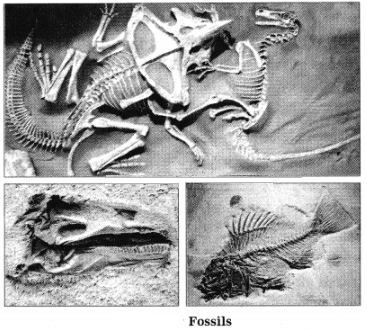
Observe the pictures given below.
Image

Answer

(1) Fossils offer palaeontological evidence for the evolutionary process.
(2) Due to some natural calamities the organisms get buried during ancient times.
(3) The impressions and remnants of such organisms remain preserved underground. The hot lava also traps some organisms or their impressions. All such formations form fossils.
(4) Study of fossils help the researcher to understand the characteristics of the organisms that existed in the.past.
(5) Carbon dating method also helps in finding out exact age of the fossil. According to the structure of earth’s crust the fossils are obtained at specific depths.
(6) The oldest ones are obtained at the depth while the relatively recent ones occupy the upper surface. Thus fossils of invertebrates were seen in very old Palaeozoic era. Later were seen fossils of Pisces, Amphibia and Reptilia. The Mesozoic era was dominated by reptiles while Coenozoic era showed presence of mammals.
(7) In this way, study of fossils unfold the evolutionary secrets.

Need a full question paper?

Generate a complete, print-ready paper with questions like this in minutes — across 16+ boards, with answer keys.

Start Generating Free

Similar questions

How does the nuclear fission process takes place in the nuclear power plant?
What happens when a ray of light is incident normal to the interface between two media? Draw the corresponding neat and labelled diagram.
Read the given passage carefully and answer the questions.
We know that the force of gravity due to the earth acts on each and every object. When we were holding the stone in our hand, the stone was experiencing this force, but it was balanced by a force that we were applying on it in the opposite direction. As a result, the stone remained at rest. Once we release the stone from our hands, the only force that acts on it is the gravitational force of the earth and the stone falls down under its influence. Whenever an object moves under the influence of the force of gravity alone, it is said to be falling freely. Thus the released stone is in a free fall. In free fall, the initial velocity of the object is zero and goes on increasing due to the acceleration due to the gravity of the earth. During free fall, the frictional force due to air opposes the motion of the object and a buoyant force also acts on the object. Thus, true free fall is possible only in a vacuum.
1) Complete the following statement by choosing the right option.
The stone held in the hand is stable because on it __.
  1. two unbalanced forces are exerted.
  2. only the gravitational force of the earth is exerted.
  3. gravitational force of the earth is not exerted.
  4. two balanced forces are exerted.
2) Why does free fall not happen on the earth?
3) Why does the velocity of the object increase during the free fall?
4) Which type of force exerts on the object during free fall?
5) Why does free fall happen only in a vacuum?
What is myopia or nearsightedness? What are the possible reasons of myopia? How is myopia corrected? Explain with diagrams.
When a person eats sugary food, then organisms A present in his mouth act on sugar to produce a substance B. The substance B first dissolves the calcium salts from the top part C of the tooth and then from its middle part D forming holes E. These holes ultimately reach the part F in the lower part of tooth which contains nerves and blood vessels. The substance B irritates the nerve endings inside the tooth causing toothache.
  1. What are (i) organisms A, and (ii) substance B?
  2. What are (i) part C, and (ii) part D, of tooth known as?
  3. By what name are the holes E in the tooth known?
  4. Name the part F of the tooth.
  5. What will happen if organisms A reach part F of the tooth known?
What is the reaction called when oxidation and reduction take place simultaneously?
2 The substances formed by specific chemical bond between fatty acids and alcohol are called lipids. Digestion of lipids consumed by us is nothing but their conversion into fatty acids and alcohol. Fatty acids are absorbed and distributed everywhere within the body. From those fatty acids, different cells produce various substances necessary to themselves. Ex. the molecules called phospholipids which are essential for producing plasma membrane are formed from fatty acids. Besides, fatty acids are used for producing hormones like progesterone, estrogen, testosterone, aldosterone, etc. and the covering around the axons of nerve cells. We get 9 Kcal of energy per gram of lipids. Excess of lipids are stored in adipose connective tissue in the body.
Questions and Answers:
(1) Define lipids.
(2) What happens to fats that are eaten in excess?
(3) Which hormones regulating reproductive functions are produced from fatty acids?
(4) How is plasma membrane of the cells formed?
(5) What happens to lipids when their digestion is completed? How much energy do they provide?
Give scientific Reason :
Atomic radius goes on decreasing while going from left to right in a period.
P is a cell (or group of cells) in the human body which is sensitive to a particular type of stimulus and conveys the messages to CNS through nerves Q. On the other hand, R is a part of the human body which can respond to a stimulus according to the instructions sent from the CNS through nerves S.
  1. What is P? Name five organs which contain cells (or group of cells) like P.
  2. Name the nerves Q.
  3. What is R? Give two examples of R.
  4. Name nerves S.
  5. How do messages travel through the nerves Q and S?
There are four tiny organisms A, B, C and D. The organism A is a parasitic protozoan which causes a disease known as kala-azar. The organism B is a microscopic single-celled animal which causes malaria disease in human beings. The organism C is a unicellular animal which can change its body shape according to need, it has no fixed shape. The organism D is also a unicellular animal which is slipper-shaped having a large number of tiny hair all around its body.
  1. Name the organisms A, B, C and D.
  2. Name one characteristic body feature of organism A.
  3. Name the insect which carries organism B and transmits it from one person to another.
  4. What name is given to the asexual method of reproduction of (i) organism A, and (ii) organism B?
  5. Where do organisms C and D live?