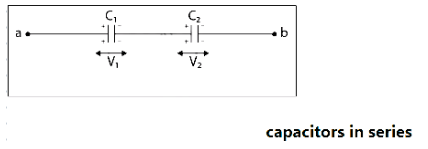
1.The second plate of the first conductor is connected to the first plate of the second conductor, and so on, in a series arrangement.
2.Charges on the plates (Q) are the same on each capacitor in a series combination.
3.The potential difference across the series combination of the capacitor is V volt,
Where, \(V=V_1+V_2\)
\(\therefore V =\frac{ Q }{ C _1}+\frac{ Q }{ C _2} \ldots \ldots \ldots . .\left( V =\frac{ Q }{ C }\right)\)
Let C represent the equivalent capacitance.
\(\therefore \frac{ Q }{ C _5}=\frac{ Q }{ C _1}+\frac{ Q }{ C _2} \ldots \ldots \ldots . .\left( V =\frac{ Q }{ C }\right)\)
\(\therefore \frac{1}{C_s}=\frac{1}{C_1}+\frac{1}{C_2}\)
\(\therefore C _{ s }=\frac{ C _1 \cdot C _2}{ C _1+ C _2}\)
The needed expression for equivalent capacitance for a pair of capacitors linked in series is given by the equation above.