Question
Obtain an expression for maximum safety speed with which a vehicle can be safely driven along a curved banked road.
Answer

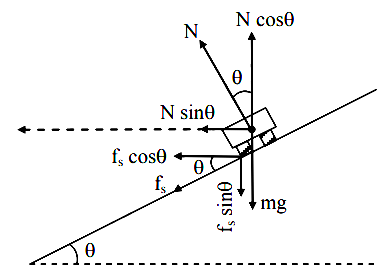
i. The vertical section of a vehicle on a curved road (considering friction) of radius ' $r$ ' banked at an angle ' $\theta$ ' with the horizontal is shown in the figure. If the vehicle is running exactly at the optimum speed, then the forces acting on the vehicle are a. weight $mg$ acting vertically downwards b. normal reaction $N$ acting perpendicular to the road. ii. But in practice, vehicles never travel exactly at this speed. iii. Hence, for speeds other than this, the component of the force of static friction between the road and the tires helps us, up to a certain limit. iv. For maximum possible speed, The component $N \sin \theta$ is less than the centrifugal force $\frac{ mv ^2}{r}$. $\therefore \frac{ mv ^2}{r}> N \sin \theta$
Banked road: upper-speed limit
$v$. In this case, the direction of the force of static friction $\left(f_s\right)$ between the road and the tires is directed along with the inclination of the road, downwards.
vi. The horizontal component $\left(f_s \cos \theta\right)$ is parallel to $N \sin \theta$. These two forces take care of the necessary centripetal force (or balance the centrifugal force).
$\therefore \frac{m v ^2}{r}=N \sin \theta+f_s \cos \theta \text {. }$
vii. The vertical component, $N \cos \theta$ balances the component $f_s \sin \theta$ and weight ' $mg$ '.
$ \therefore N \cos \theta= f _{ s } \sin \theta+ mg$
$\therefore mg = N \cos \theta- f _{ s } \sin \theta $
viii. For maximum possible speed, $fs _{ s }$ is maximum and equal to $\mu_{ s } N$. From equations ( 1 ) and (2),
$v _{\max }=\sqrt{r g\left(\frac{\tan \theta+\mu_s}{1-\mu_s \tan \theta}\right)}$
This is an expression for maximum safety speed with which a vehicle can be safely driven along a curved banked road (considering friction).
x. From equation (3) and equation (4) we can write,
$ \left(\frac{\tan \theta+\mu_s}{1-\mu_s \tan \theta}\right)=\frac{V_{\max }^2}{r g} \ldots . . . .(5)$
$\text { and } \tan \theta=\frac{V_{\max }^2}{r g}$
$\therefore \theta=\tan ^{-1}\left(\frac{V_{\max }^2}{r g}\right) . . . \ldots \ldots \ldots \ldots . . .(6) $
From equation (5) and equation (6), angle of banking is independent of mass of vehicle.

Need a full question paper?

Generate a complete, print-ready paper with questions like this in minutes — across 16+ boards, with answer keys.

Start Generating Free

Similar questions

An AC circuit consists of only an inductor of inductance 2 H. If the current is represented by a sine wave of amplitude 0.25 A and frequency 60 Hz, calculate the effective potential difference across the inductor (π = 3.142)
Describe geometry of the Young’s double slit experiment with the help of a ray diagram. What is fringe width? Obtain an expression of it. Write the conditions for constructive as well as destructive interference.
In a metre bridge experiment, with a resistance $R_1$ in the left gap and a resistance $X$ in the right gap, the null point is obtained at $40 \ cm$ from the left end of the wire. With a resistance $R_2$ in the left gap and the same resistance $X$ in the right gap, the null point is obtained at 50 $cm$ from the left end of the wire. Where will be the null point if $R_1$ and $R_2$ are connected first in series and then in parallel in the left gap, the right gap still containing $X$ ?
Somehow, an ant is stuck to the rim of a bicycle wheel of diameter $1\ m.$ While the bicycle is on a central stand, the wheel
is set into rotation and it attains the frequency of $2$ rev/s in $10$ seconds, with uniform angular acceleration. Calculate
(i) Number of revolutions completed by the ant in these 10 seconds.
(ii) Time taken by it for first complete revolution and the last complete revolution.
 
We have mentioned about ‘static friction’ between road and tyres. Why is it static friction? What about kinetic friction between road and tyres?
State Einstein’s photoelectric equation. Explain all characteristics of the photoelectric effect, on the basis of Einstein’s photoelectric equation.
The optical path of a ray of light of a given wavelength travelling a distance of $3\ cm$ in flint glass having refractive index $1.6$ is same as that on travelling a distance x cm through a medium having refractive index $1.25$. Determine the value of x.
 
Calculate the magnitude of the magnetic induction due to a circular coil of $400$ turns and radius $0.05 m$, carrying a current of $5 A$, at a point on the axis of the coil at a distance $0.1 m$.
What is meant by polarized light? How does it differ from unpolarized light?
As the electron revolves in the second Bohr orbit in the hydrogen atom, the corresponding current is $($about$) 1.3 \times 10^{-4} A$. If the area of the orbit is $($about$) 1.4 \times 10^{-19} m ^2$, what is the $($approximate$)$ equivalent magnetic moment?