Question
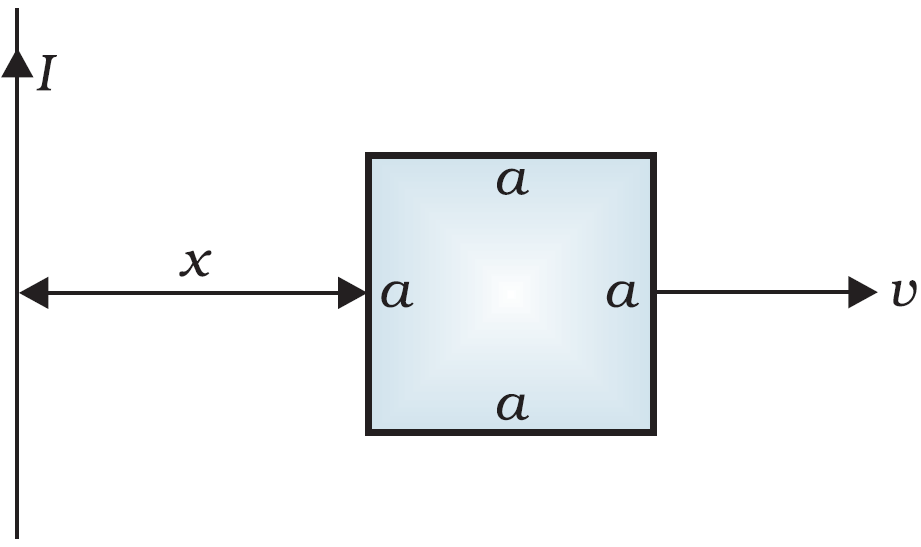
  1. Obtain an expression for the mutual inductance between a long straight wire and a square loop of side a as shown in Fig.
  2. Now assume that the straight wire carries a current of 50A and the loop is moved to the right with a constant velocity, v = 10\m/s. Calculate the induced emf in the loop at the instant when x = 0.2m. Take a = 0.1m and assume that the loop has a large resistance.
Answer

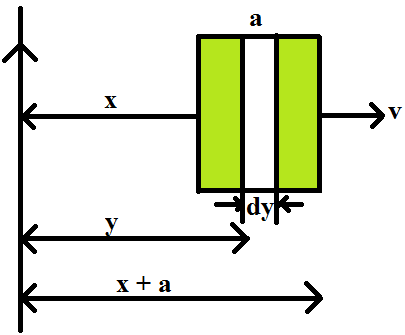
  1. Take a small element dy in the loop at a distance y from the long straight wire (as shown in the given figure).
Magnetic flux associated with element dy, $\text{d}\phi=\text{BdA}$
Where,
dA = Area of element dy = ady
B = Magnetic field at distance y
$=\frac{\mu_0\text{I}}{2\pi\text{y}}\text{s}$
I = Current in the wire
$\mu_0=\text{Permeability of free space}=4\pi\times10^{-7}\text{Tm}\text{A}^{-1}$
$\therefore\ \text{d}\phi=\frac{\mu_0\text{Ia}}{2\pi}\frac{\text{dy}}{\text{y}}\text{s}$
$\phi=\frac{\mu_0\text{Ia}}{2\pi}\int\frac{\text{dy}}{\text{y}}$
y tends from x to a + x.s
$\therefore\ \phi=\frac{\mu_0\text{I}\text{a}^{\text{a}+\text{x}}}{2\pi}\int_{\text{x}}\frac{\text{dy}}{\text{y}}$
$=\frac{\mu_0\text{Ia}}{2\pi}\big[\log_{\text{e}}\text{ y}\big]_{\text{x}}^{\text{a}+\text{x}}$
$=\frac{\mu_0\text{Ia}}{2\pi}\log_{\text{e}}\Big(\frac{\text{a}+\text{x}}{\text{x}}\Big)$
For mutual inductance M, the flux is given as:
$\phi=\text{mI}$
$\therefore\ \text{mI}=\frac{\mu_0\text{Ia}}{2\pi}\log_{\text{e}}\Big(\frac{\text{a}}{\text{x}}+1\Big)$
$\text{m}=\frac{\mu_0\text{a}}{2\pi}\log_{\text{e}}\Big(\frac{\text{a}}{\text{x}}+1\Big)$
  1. Emf induced in the loop, $\text{e}=\text{B}'\text{av}\Big(\frac{\mu_0}{2\pi}\Big)\text{av}$ Given,
I = 50A
x = 0.2m
a = 0.1m
v = 10m/s
$\text{BQv}=\frac{\text{M}\text{v}^2}{\text{r}}$
$\therefore\ \text{B}2\pi\text{r}\lambda\text{r}^2=\frac{\text{Mv}}{\text{r}}$
$\text{v}=\frac{\text{B}2\pi\text{r}\lambda\text{r}^2}{\text{M}}$
$\text{For }\text{r}\leq\text{a}\text{ and }\text{a}<\text{R},\ \text{we get}:$
$(\text{i})=-\frac{2\text{B}_0\text{a}^2\lambda}{\text{MR}}\text{k}$
$e = 5 \times 10^{-5}V$

Need a full question paper?

Generate a complete, print-ready paper with questions like this in minutes — across 16+ boards, with answer keys.

Start Generating Free

Similar questions

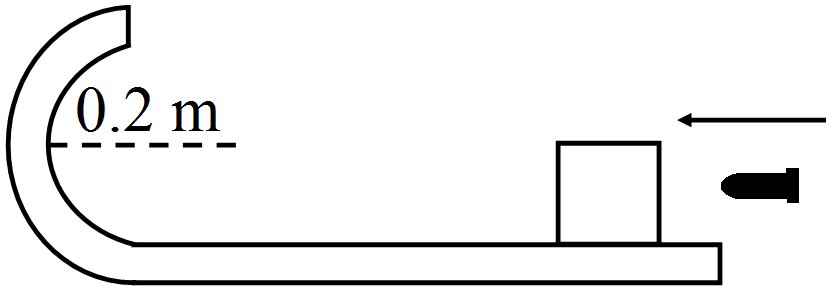
A bullet of mass 10g moving horizontally at a speed of 5017m/s strikes a block of mass 490g kept on a frictionless track as shown in figure. The bullet remains inside the block and the system proceeds towards the semicircular track of radius 0.2m. Where will the block strike the horizontal part after leaving the semicircular track ?
Suppose India had a target of producing by 2020 AD, 200,000 MW of electric power, ten percent of which was to be obtained from nuclear power plants. Suppose we are given that, on an average, the efficiency of utilization (i.e. conversion to electric energy) of thermal energy produced in a reactor was 25%. How much amount of fissionable uranium would our country need per year by 2020? Take the heat energy per fission of $^{235}\text{U}$ to be about 200MeV.
(i) How will you show that Lenz's law is a conclusion of energy conservation law? Explain with suitable examples.

(ii) Using the expression for Lorentz force applied on charge carriers of any conductor, obtain an expression for that induced emf which is induced in a conductor of length $l$ moving with a velocity $v$, perpendicular to any magnetic field $B$.
An optical instrument used for angular magnification has a 25D objective and a 20D eyepiece. The tube length is 25cm when the eye is least strained.
  1. Whether it is a microscope or a telescope?
  2. What is the angular magnification produced?
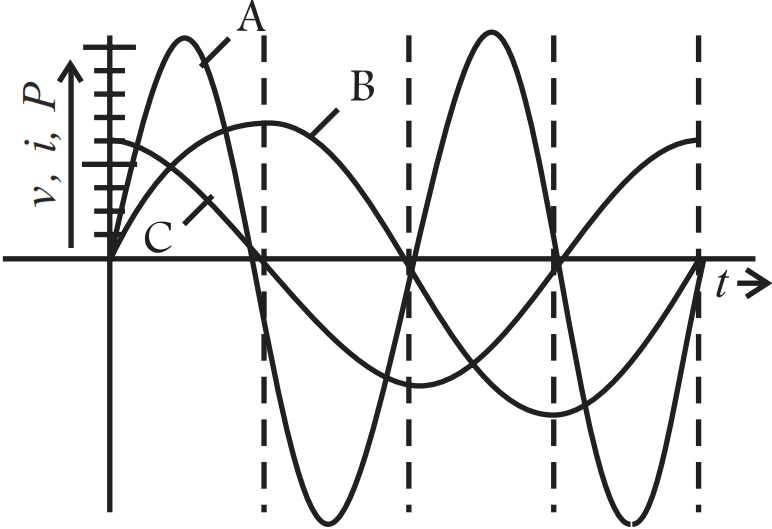
A device 'X' is connected to an a.c source. The variation of voltage, current and power in one complete cycle is shown in Fig.
  1. Which curve shows power consumption over a full cycle?
  2. What is the average power consumption over a cycle?
  3. Identify the device 'X'.
The radius of a gold nucleus (Z = 79) is about $7.0 \times 10^{-15}m$. Assume that the positive charge is distributed uniformly throughout the nuclear volume. Find the strength of the electric field at:
  1. The surface of the nucleus.
  2. At the middle point of a radius. Remembering that gold is a conductor, is it justified to assume that the positive charge is uniformly distributed over the entire volume of the nucleus and does not come to the outer surface?
Air is pumped into the tubes of a cycle rickshaw at a pressure of 2 atm. The volume of each tube at this pressure is $0.002m^3.$ One of the tubes gets punctured and the volume of the tube reduces to $0.0005m^3.$ How many moles of air have leaked out? Assume that the temperature remains constant at 300K and that the air behaves as an ideal gas.
Monochromatic light of wavelength 589 nm is incident from air on a water surface. What are the wavelength, frequency and speed of (a) reflected, and (b) refracted light? Refractive index of water is 1.33.
A long, straight wire carries a current i. Let $B_1$, be the magnetic field at a point Pat a distance d from the wire. Consider a section of length l of this wire such that the point P lies on a perpendicular bisector of the section. Let B2 be the magnetic field at this point due to this section only. Find the value of $\frac{\text{d}}{\text{l}}$ so that $B_2$ differs from $B_$1, by 1%.
In an agricultural experiment, a solution containing 1 mole of a radioactive material $\Big(\text{t}_{\frac{1}{2}}=14.3\text{ days}\Big)$ was injected into the roots of a plant. The plant was allowed 70 hours to settle down and then activity was measured in its fruit. If the activity measured was $1\mu\text{Ci},$ what per cent of activity is transmitted from the root to the fruit in steady state?