Question
Obtain expression for force on unit length of two straight parallel current carrying conductors. Under what conditions is this force attractive or repulsive? Define the standard unit of electric current.
Answer

Force between Two Parallel Current Carrying Conductors :
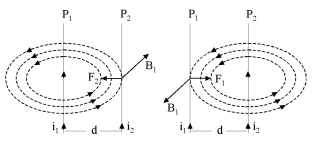
In the given figure, $P _1$ and $P _2$ are two current carrying conductors of infinite length which are situated at a distance $d$ from each other in the plane of the paper.
Current $i_1$ and $i_2$ are flowing in the same direction in the two wires and due to this magnetic field will be produced around them.
Here one current carrying conductor is present in the produced magnetic field due to other current carrying conductor.
Magnetic field produced at a distance $d$ due to current carrying conductor $P _1$
$ B_1=\frac{\mu_0 i_1}{2 \pi d} $
Force acting on length $/$ of current carrying conductor $P _2$ present in this magnetic field
$\overrightarrow{ F }_2={ }_{i_2}\left(\vec{l} \times \overrightarrow{ B }_1\right)$
$F _2=i_2 / B _1 \sin \theta$
$F _2=i_2 / B _1$
$\because\left[\vec{l} \perp \overrightarrow{B}_1\right] $
On putting value of $B _1$ from equation $(1),$
$ F_2=i_2 l \times \frac{\mu_{o} i_1}{2 \pi d}$
$F_2=\frac{\mu_{o} i_2 l}{2 \pi d} \text { Newton } $
Direction of this force $F _2$ is perpendicular to the current carrying conductor $P _2$ and magnetic force $B _1$ produced on it.
Hence this force is inward the plane of paper and towards conductor $P _1$.
This direction of force can be determined with the help of Fleming's left-hand rule.
$ \frac{F_2}{T}=\frac{\mu_0 i_1 i_2}{2 \pi d} N / m $
This is magnetic force working on unit length of current carrying conductor $P _2$.
Magnetic field produced at a distance $d$ due to current carrying conductor
$P _2$. $ B_2=\frac{\mu_0 i_2}{2 \pi d} $
Magnetic field working on unit length $/$ of $P _1$ due to $P _2$,
$\overrightarrow{ F }_1=i_1\left(\vec{l} \times \overrightarrow{ B }_2\right) \quad$ or $ F _1=i_1 / B _2$
or $F _1=\frac{i_1 / \mu_0 i_2}{2 \pi d}$
Image
or $ F _1=\frac{\mu_0 i_1 i_2 l}{2 \pi d}$
or $ \frac{F_1}{T}=\frac{\mu_0 i_1 i_2}{2 \pi d} N / m $
From equations $ (3)$ and $(4),$
$ \frac{F_1}{T}=\frac{F_2}{l}=\frac{\mu_{o} i_1 i_2}{2 \pi d} N / m $
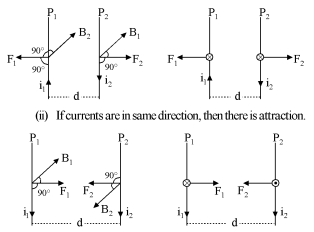
It is clear from the figure that when current in two parallel current carrying conductors is in the same direction, force of attraction is exerted between them.
Special conditions :
$(i) $ If currents are in mutually opposite directions, then there will be repulsion
Image
Mutual force acting on each wire per unit length of two parallel wires
$\frac{ F _1}{l}=\frac{\mu_0}{2 \pi}\left(\frac{i_1 i_2}{d}\right) N / m$
But $\mu_0=4 \pi \times 10^{-7} N / m ^2$
Hence, $\frac{ F _1}{l}=\frac{4 \pi \times 10^{-7}}{2 \pi}\left(\frac{i_1 i_2}{d}\right) N / m$
$=\left(2 \times 10^{-7}\right)\left(\frac{i_1 i_2}{d}\right) N / m$
If $i_1=i_2=i$ ampere and $d=1 m$, then $F _{1 / l}=\left(2 \times 10^{-7}\right) i^2 N / m$
Therefore, if the force applied per meter length between these wires is $2 \times 10^{-7}$ then $1$ Ampere current will flow through the wires.
So $1$ ampere is that electric current which when flows through two straight, long and parallel wires kept at a distance of $1$ m from each other in air $($or vacuum$)$ exerts a force of $2 \times 10^{-7} N / m$ on one meter length of each wire.

Need a full question paper?

Generate a complete, print-ready paper with questions like this in minutes — across 16+ boards, with answer keys.
Start Generating Free

Similar questions

We have stimulated emission and spontaneous emission. Do we also have stimulated absorption and spontaneous absorption?
$(I) (a)$ A giant refracting telescope at an observatory has an objective lens of focal length $15 m$. If an eyepiece of focal length $1.0 \ cm$ is used, what is angular magnification of the telescope in normal adjustment?
$(b)$ If this telescope is used to view the moon, what is the diameter of the image of the moon formed by the objective lens? The diameter of the moon is $3.48 \times 10^6 m$ and the radius of lunar orbit is $3.8 \times 10^8 m$.
A pin of length 2.00cm is placed perpendicular to the principal axis of a converging lens. An inverted image of size 1.00cm is formed at a distance of 40.0cm from the pin. Find the focal length of the lens and its distance from the pin.
Can the work by kinetic friction on an object be positive? Zero?
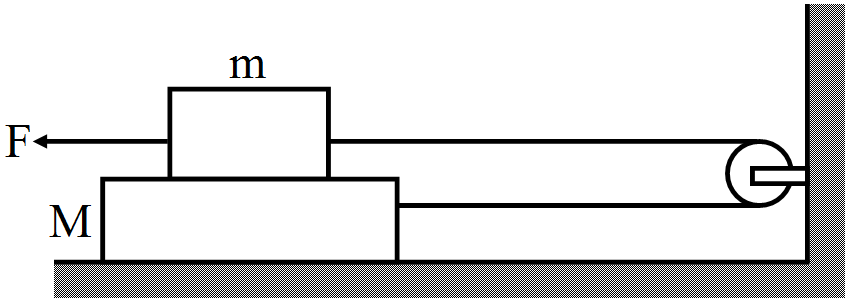
The friction coefficient between the two blocks shown in figure is $\mu$ but the floor is smooth.
  1. What maximum horizontal force F can be applied without disturbing the equilibrium of the system?
  2. Suppose the horizontal force applied is double of that found in part (a). Find the accelerations of the two masses.
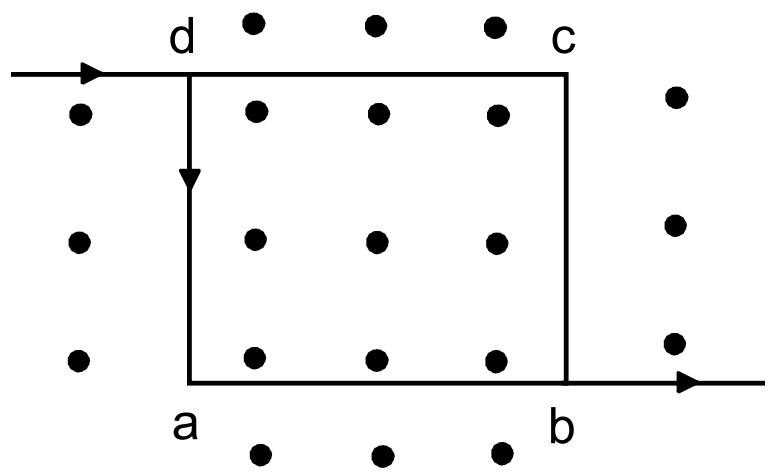
A current of 2A enters at the corner d of a square frame abcd of side 20cm and leaves at the opposite corner b. A magnetic field B = 0.1 T exists in the space in a direction perpendicular to the plane of the frame, as shown in the figure. Find the magnitude and direction of the magnetic forces on the four sides of the frame.
An electric kettle used to prepare tea, takes 2 minutes to boil 4 cups of water (1 cup contains 200cc of water) if the room temperature is 25C.
  1. If the cost of power consumption is Rs. 1.00 per unit (1 unit - 1000 watt-hour), calculate the cost of boiling 4 cups of water.
  2. What will be the corresponding cost if the room temperature drops to 5°C?
Find the speed at which the kinetic enei:gy of a particle will differ by 1% from its nonrelativistic value $\frac{1}{2}\text{m}_0\text{v}^2$
Two point charges of $+5 \times 10^{-19}C$ and $+20 \times 10^{-19}C$ are separated by a distance of 2m. Find the point on the line joining them at which electric field intensity is zero.
Calculate potential on the axis of a ring due to charge Q uniformly distributed along the ring of radius R.