Current Electricity — Physics STD 12 Science — Question
Maharashtra BoardEnglish MediumSTD 12 SciencePhysicsCurrent Electricity4 Marks
Question
Obtain the balancing condition in case of a Wheatstone’s network.
✓
Answer
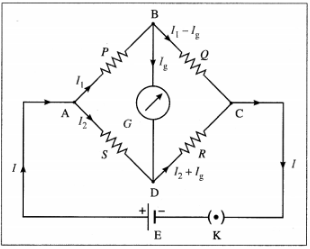
Wheatstone’s network or bridge is a circuit for indirect measurement of resistance by null com-parison method by comparing it with a standard known resistance. It consists of four resistors with resistances P, Q, R and S arranged in the form of a quadrilateral ABCD. A cell (E) with a plug key (K) in series is connected across one diagonal AC and a galvanometer (G) across the other diagonal BD as shown in the following figure.
With the key K dosed, currents pass through the resistors and the galvanometer. One or more of the resistances is adjusted until no deflection in the galvanometer can be detected. The bridge is then said to be balanced.
Let I be the current drawn from the cell. At junction A , it divides into a current $I _1$ through P and a current $I _2$ through
S.
$I=I_1+I_2$ (by Kirchhoff's first law).
At junction B , current $I _{ g }$ flows through the galvanometer and current $I _1- I _{ g }$ flows through Q . At junction $D , I _2$ and $I _{ g }$ combine. Hence, current $I _2+ I _{ g }$ flows through R from D to C . At junction $C , I _1- I _{ g }$ and $I _2+ I _{ g }$ combine. Hence, current $I_1+I_2(=I)$ leaves junction $C$.
Applying Kirchhoff’s voltage law to loop ABDA in a clockwise sense, we get,
$– I_1P – I_gG + I_2S = 0 …………… (1)$
where G is the resistance of the galvanometer.
Applying Kirchhoff’s voltage law to loop BCDB in a clockwise sense, we get,
$– (I_1 – I_g)Q + (I_2 + I_g)R + I_gG = 0 ………….. (2)$
When $I_g$ = 0, the bridge (network) is said to be balanced. In that case, from Eqs. (1) and (2), we get,
$I _1 P = I _2 S$
and $I_1 Q = I _2 R$
(4)
From Eqs. (3) and (4), we get,
$
\frac{P}{Q}=\frac{S}{R}
$
This is the condition of balance.
Alternative Method: When no current flows through the galvanometer, points $B$ and $D$ must be at the same potential.
$
\therefore V _{ B }= V _{ D }
$
$
\therefore V_A-V_B=V_A-V_D
$
and $V_B-V_C=V_D-V_C \ldots \ldots \ldots .$. (2)
Now, $V_A-V_B=I_1 P$ and $V _{ A }- V _{ D }= I _2 S$
Also, $V_B-V_C=I_1 Q$ and $V_D-V_C=I_2 R$
Substituting Eqs. (3) and (4) in Eqs. (1) and (2), we get,
$
I _1 P = I _2 S \text {. }
$
and $I _1 Q = I _2 R$...(6)
Dividing Eq. (5) by Eq. (6), we get,
$
\frac{P}{Q}=\frac{S}{R}
$
This is the condition of balance.
Need a full question paper?
Generate a complete, print-ready paper with questions like this in minutes — across 16+ boards, with answer keys.