Question
Obtain the expression for the period of a simple pendulum performing S.H.M.

Answer

An ideal simple pendulum is defined as a heavy point mass suspended from a rigid support by a weightless, inextensible and twistless string, and set oscillating under gravity through a small angle in a vertical plane.In practice, a small but heavy sphere, called the bob, is used. The distance from the point of suspension to the centre of gravity of the bob is called the length of the pendulum.
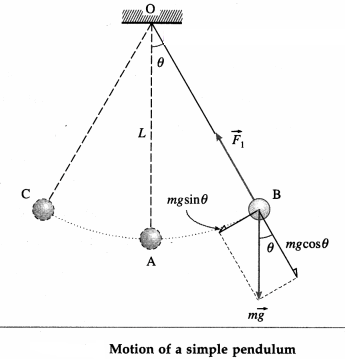
Consider a simple pendulum of length $L_1 $– suspended from a rigid support O. When displaced from its initial position of rest through a small angle θ in a vertical plane and released, it performs oscillations between two extremes, B and C, as shown in below figure.
At B, the forces on the bob are its weight $m \vec{g}$ and the tension $\overrightarrow{F_1}$ in the string. Resolve $m \vec{g}$ into two components : $mg \cos \theta$ in the direction opposite to that of the tension and $mg$ $\sin \theta$ perpendicular to the string.


Image
mg cos θ balanced by the tension in the string. mg sin θ restores the bob to the equilibrium position.
Restoring force, F = – mg sin θ
If θ is small and expressed in radian,
$ \sin \theta \approx \theta=\frac{\operatorname{arc}}{\text { radius }}=\frac{ AB }{ OB }=\frac{x}{L}$
$\therefore F =- mg \theta=- mg \frac{x}{L} \ldots .(1)$
Since $m, g$ and $L$ are constant,
$F \propto(-x) \ldots .(2)$
Thus, the net force on the bob is in the direction opposite to that of displacement x of the bob from its mean position as indicated by the minus sign, and the magnitude of the force is proportional to the magnitude of the displacement. Hence, it follows that the motion of a simple pendulum is linear SHM.
Acceleration, $a =\frac{F}{m}=-\frac{g}{L} \times \ldots$ (3)
Therefore, acceleration per unit displacement $=\left|\frac{a}{x}\right|=\frac{g}{L} \ldots .$. (4)
Period of SHM,
$T=\frac{2 \pi}{\sqrt{\text { acceleration per unit displacement }}}$
$=\frac{2 \pi}{\sqrt{g / L}} \quad \therefore T=2 \pi \sqrt{\frac{L}{g}}$
This gives the expression for the period of a simple pendulum.

Need a full question paper?

Generate a complete, print-ready paper with questions like this in minutes — across 16+ boards, with answer keys.
Start Generating Free

Similar questions

Calculate the value of capacitance in picofarad, which will make 101.4 micro henry inductance to oscillate with frequency of one megahertz.
A stretched sonometer wire emits a fundamental note of frequency $256 Hz$. Keeping the stretching force constant and reducing the length of the wire by $10 cm$, the frequency becomes $320 Hz$. Calculate the original length of the wire.
State the difficulties faced by Rutherford’s atomic model.
What is the amount of ${ }_{27}^{60}$ Co necessary to provide a radioactive source of strength $10.0\ mCi$, its half-life being $5.3$ years?
A satellite moves around the Earth in an elliptical orbit such that at perigee (closest approach) it is two Earth radii above the Earth's surface. At apogee (farthest position), it travels with one-fourth the speed it has at perigee. In terms of the Earth's radius R, what is the maximum distance of the satellite from the Earth's surface?
Determine the maximum angular speed of an electron moving in a stable orbit around the nucleus of hydrogen atom.
The lower end of a capillary tube of diameter $1 \mathrm{~mm}$ is dipped $10 \mathrm{~cm}$ below the water surface in a beaker. What pressure is required to blow a hemispherical air bubble at the lower end of the tube? Present your answer rounded off to 4 significant figures. [Surface tension $=0.072$ $\mathrm{N} / \mathrm{m}$, density $=10^3 \mathrm{~kg} / \mathrm{m}^3$, atmospheric pressure $\left.=101.3 \mathrm{kPa}, \mathrm{g}=9.8 \mathrm{~m} / \mathrm{s}^2\right]$
An object of mass $0.5 kg$ performs SHM with force constant $10 N / m$ and amplitude $3 cm$.
(i) What is the total energy of the object?
(ii) What is its maximum speed?
(iii) What is its speed at $x=2 cm$ ?
(iv) What are its kinetic and potential energies at $x=2 cm$ ?
In a biprism experiment, the fringes are observed in the focal plane of the eyepiece at a distance of $1.2\ m$ from the slits. The distance between the central bright band and the $20$th bright band is $0.4\ cm.$ When a convex lens is placed between the biprism and the eyepiece, $90\ cm$ from the eyepiece, the distance between the two virtual magnified images is found to be $0.9\ cm.$ Determine the wavelength of light used.
Explain the concept/phenomenon of mutual induction.###Explain and define mutual inductance of a coil with respect to another coil.###Define the coefficient of mutual induction.