Question
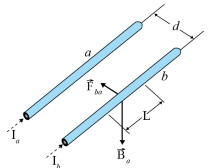
Obtain the formula for force acting between two parallel straight current carrying conductors and hence define one ampere.
Need a full question paper?

Generate a complete, print-ready paper with questions like this in minutes — across 16+ boards, with answer keys.

Start Generating Free

Similar questions

Establish a relationship between electric current and drift velocity. Draw the direction of electron flowing in a circuit by drawing an electric circuit.
Find the ratio of the linear momenta of two particles of masses 1.0kg and 4.0kg if their kinetic energies are equal.
  1. State the law of radioactive decay. Write the SI unit of ‘activity’.
  2. There are $4\sqrt{2}\times10^6$ radioactive nuclei in a given radioactive sample. If the half life of the sample is 20 s, how many nuclei will decay in 10 s?
The critical angle for a given piece of glass is 45°. Calculate the polarising angle for it. Also calculate the angle of refraction when light is incident on this glass at an angle of incidence equal to ip.
A hollow charged conductor has a tiny hole cut into its surface. Show that the electric field in the hole is (σ/2ε0) $\hat{\text{n}}$ , where $\hat{\text{n}}$ is the unit vector in the outward normal direction, and σ is the surface charge density near the hole.
Define the term ‘mutual inductance’ between the two coils.
Obtain the expression for mutual inductance of a pair of long coaxial solenoids each of length l and radii r1 and r2 (r2 >> r1). Total number of turns in the two solenoids are N1 and N2 respectively.
What do electromagnetic waves consist of ? Explain on what factors does its velocity in vacuum depend?
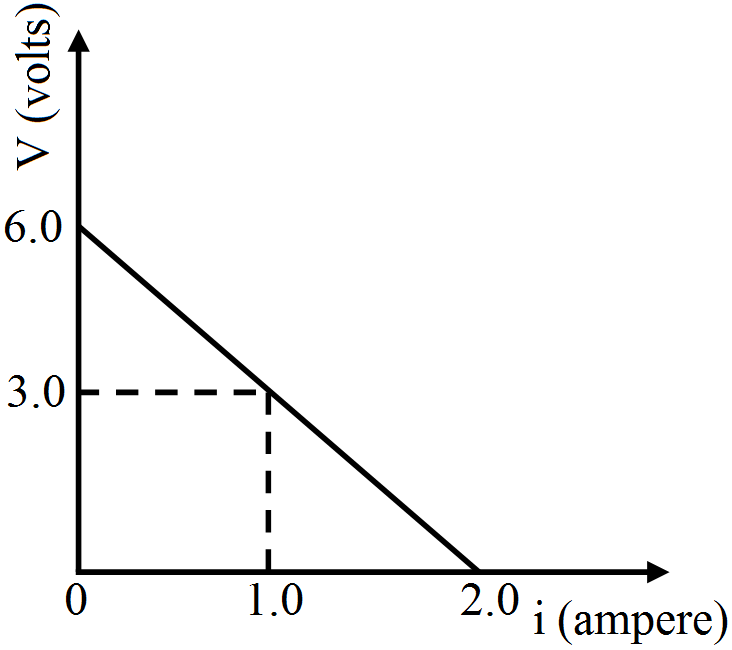
The graph shown here shows the variation of terminal potential difference V, across a combination of three cells in series to a resistor, versus current i:

  1. Calculate the emf of each cell.
  2. For what current i, will the power dissipation of the circuit be maximum?
Write Maxwell’s generalisation of Ampere’s Circuital Law. Show that in the process of charging a capacitor, the current produced within the plates of the capacitor is
 $\text{i} = \varepsilon_{\circ}\frac{^{\text{d}\Phi}\text{E}}{\text{dt}}$where$\Phi_{E}$ is the electric flux produced during charging of the capacitor plates.
Draw a circuit diagram of a C.E. transistor amplifier. Briefly, explain its working and write the expression for (i) current gain, (ii) voltage gain of the amplifier.