Question
Obtain the magnification by lens after giving the definition.

Answer

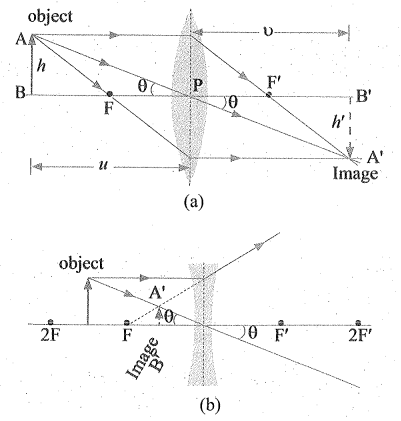
Image
→The ratio of the size of the image obtained by lens to that of the object is called magnification.
$m=\frac{h^{\prime}}{h}......(1)$
→As shown in figure AB is an object and its image is $A ^{\prime} B ^{\prime}$.
→From figure $\triangle ABP$ and $\triangle A ^{\prime} B ^{\prime} P$ are similar triangles.
$\therefore \quad \frac{ A ^{\prime} B ^{\prime}}{ AB }=\frac{ B ^{\prime} P }{ BP }$
→$\begin{array}{lll}\text { But, } & A ^{\prime} B ^{\prime}=-h^{\prime} & AB =h \\ & B^{\prime} P =v & BP =-u\end{array}$
→Substituting these values in above equation,
$\begin{array}{l}\therefore \frac{-h^{\prime}}{h}=-\frac{v}{u} \\\therefore \frac{h^{\prime}}{h}=\frac{v}{u}......(2)\end{array}$
→Comparing equation (1) and (2),
$\therefore m=\frac{v}{u}$
→If the image formed by lens is virtual then magnification $(m)$ is positive and if the image formed by lens is real then magnification $(m)$ is negative.

Need a full question paper?

Generate a complete, print-ready paper with questions like this in minutes — across 16+ boards, with answer keys.
Start Generating Free

Similar questions

The specific heat capacities of hydrogen at constant volume and at constant pressure are 2.4cal-g-1 °C−1 and 3.4cal-g-1 °C-1 respectively. The molecular weight of hydrogen is 2g-mol-1 and the gas constant, R = 8.3 × 10⁷ erg°C-1 mol-1. Calculate the value of J.
Derive the equation of drift velocity by explaining the drift motion of electrons and the drift velocity of electrons in a conductor.
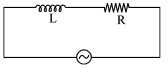
In the given figure, voltage across the ends of inductor ( L ) and resistor ( R ) is 120 V and 90 V respectively. The root mean square value of the current is 3 A. Calculate :
(i) impedance of the circuit and (ii) phase difference between voltage and current.
Image
Obtain the first Bohr’s radius and the ground state energy of a muonic hydrogen atom [i.e., an atom in which a negatively charged muon $(\mu)$ of mass about 207me orbits around a proton].
Consider the situation of the previous problem. Suppose the production of the radioactive isotope starts at t = 0. Find the number of active nuclei at time t.
With the help of a suitable diagram, explain the formation of depletion region in a p-n junction. How does its width change when the junction is (i) forward biased, and (ii) reverse biased?
  1. An X-ray tube produces a continuous spectrum of radiation with its short wavelength end at 0.45 Å. What is the maximum energy of a photon in the radiation?
  2. From your answer to (a), guess what order of accelerating voltage (for electrons) is required in such a tube?
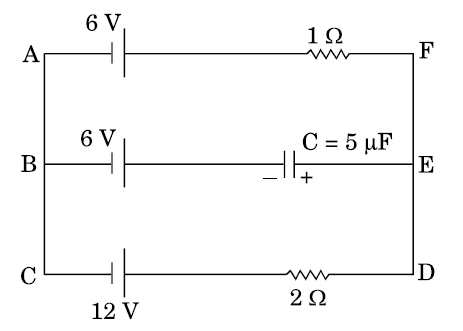
In the given circuit, with steady current, calculate the potential difference across the capacitor and the charge stored in it.

Mass of a particle depends on its speed. Does the attraction of the earth on the particle also depend on the particle's speed?
A sample of paramagnetic salt contains 2.0 × 1024 atomic dipoles each of dipole moment 1.5 × 10⁻²³ J T–1. The sample is placed under a homogeneous magnetic field of 0.64 T, and cooled to a temperature of 4.2 K. The degree of magnetic saturation achieved is equal to 15%. What is the total dipole moment of the sample for a magnetic field of 0.98 T and a temperature of 2.8 K? (Assume Curie’s law)