Chemical Thermodynamics — Chemistry STD 12 Science — Question
Maharashtra BoardEnglish MediumSTD 12 ScienceChemistryChemical Thermodynamics4 Marks
Question
Obtain the relatioship between $\triangle H$ and $\triangle U$ for gas phase reactions.
✓
Answer
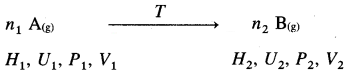
Consider a reaction in which $n _1$ moles of gaseous reactant in initial state change to $n _2$ moles of gaseous product in the final state.
Let $\ce{H_1, U_1, P_1, V_1}$ and $\ce{H_2, U_2, P_2, V_2}$ represent enthalpies, internal energies, pressures and volumes in the initial and final states respectively then,
The heat of reaction is given by enthalpy change $\Delta H$ as, $\ce{\Delta H = H_2 - H_1}$
By definition, $\ce{H = U + PV}$
$\therefore \ce{H_1= U_1 + P_1 V_1}$ and $\ce{H_2= U _2 + P_2 V_2}$
$\therefore \ce{\Delta H =\left( U_2 + P_2V_2\right)-\left( U _1 + P_1V_1\right)}$
$\ce{=\left( U 2- U _1\right) + \left( P_2 V_2 - P_1V_1\right)}$
Now, $\Delta U = U _2- U _1$
Since $P V=n R T_1$
For initial state, $P_1 V_1=n_1 R T$
For final state, $P_2 V_2=n_2 R T$
$\therefore P_2 V_2-P_1 V_1=n_2 R T-n_1 R T$
$=\left(n_2-n_1\right) R T$
$=\Delta n R T$
where $\Delta n$
$\begin{array}{l}
=\left[\begin{array}{c}
\text { Number of moles } \\
\text { of gaseous products }
\end{array}\right]-\left[\begin{array}{c}
\text { Number of moles of } \\
\text { gaseous reactants }
\end{array}\right] \\
\therefore \Delta H=\Delta U+\Delta n R T
\end{array}$
If $Q_P$ and $Q_V$ are the heats involved in the reaction at constant pressure and constant volume respectively, then since $Q_P=\Delta H$ and $Q_V=\Delta U$.
$\therefore Q _{ P }= Q _V=\Delta nRT$
Need a full question paper?
Generate a complete, print-ready paper with questions like this in minutes — across 16+ boards, with answer keys.