Question
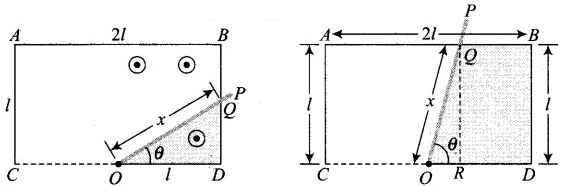
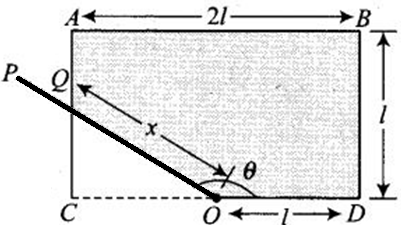
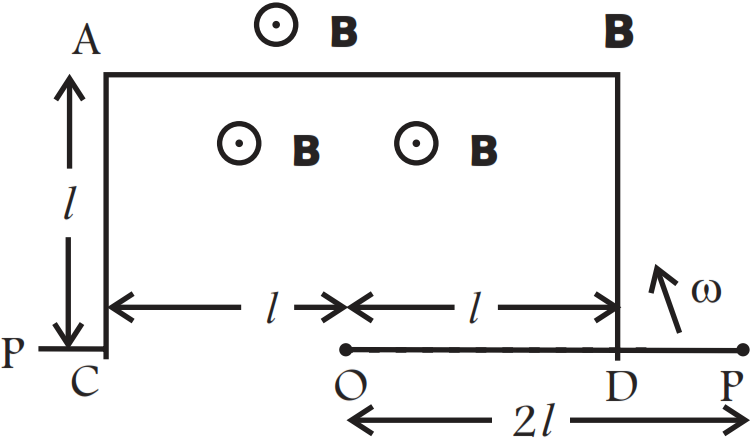
ODBAC is a fixed rectangular conductor of negilible resistance (CO is not connnected) and OP is a conductor which rotates clockwise with an angular velocity $\omega$ (Fig). The entire system is in a uniform magnetic field B whose direction is along the normal to the surface of the rectangular conductor ABDC. The conductor OP is in electric contact with ABDC. The rotating conductor has a resistance of $\lambda$ per unit length. Find the current in the rotating conductor, as it rotates by 180º.
Answer


Key concept: When the conductor OP is rotated, then the rate of change if area hence the rate of change of flux can be considered uniform from $0<\theta <\frac{\pi}{4};\frac{\pi}{4}<\theta<\frac{3\pi}{4}\text{ and }\frac{3\pi}{4}<\theta<\frac{\pi}{2}$.
  1. Let us first assume the position of rotating conductor at time interval
$\text{t}=0 \text{ to }\text{t}=\frac{\pi}{4\omega}\Big(\text{or}\frac{\text{T}}{8}\Big)$

The rod OP will make contact with the side BD. Let the length OQ of the contact after some time interval t such that $0<\text{t}<\frac{\pi}{4\omega}$ or $0<\text{t}<\frac{\text{T}}{8}$ be x. The flux through the area ODQ is,
$\phi_\text{m}=\text{BA}=\text{B}\Big(\frac{1}{2}\times\text{QD}\times\text{OD}\Big)=\Big(\frac{1}{2}\times\text{l}\tan\theta\times\text{l}\Big)$
$\Rightarrow\ \phi_\text{m}=\frac{1}{2}\text{Bl}^2\tan\theta,\text{where}\theta=\omega\text{t}$
By applying Faraday's law of EMI,
Thus, the magnitude of the emf induced is $|\in|=\Big|\frac{\text{d}\phi}{\text{dt}}\Big|=\frac{1}{2}\text{Bl}^2\omega\sec^2\omega\text{t}$
The current induced in the circuit will be $\text{I}=\frac{\in}{\text{R}}$ where, R is the where $\text{R}\propto\lambda$.
$\text{R}=\lambda\text{x}=\frac{\lambda\text{l}}{\cos\omega\text{t}}$
$\therefore\ \text{I}=\frac{1}{2}\frac{\text{Bl}^2\omega}{\lambda\text{l}}\sec^2\omega\text{t}\cos\omega\text{t}=\frac{\text{Bl}\omega}{2\lambda\cos\omega\text{t}}$
  1. Now let the rod OP will make contact with the side AB. And the length of OQ of the contact after some time interval t such that $\frac{\pi}{4\omega}<\text{t}<\frac{3\phi}{4\omega}$ or $\frac{\text{T}}{8}<\text{t}<\frac{3\text{t}}{8}$ be x. The flux though the area OQBD is,
$\phi_\text{m}=\Big(\text{l}^2+\frac{1}{2}\frac{\text{l}^2}{\tan\theta}\Big)\text{B}$
where, $\theta=\omega\text{t}$
Thus, the magnitude of emf indueced in loop is
$|\in|=\Big|\frac{\text{d}\phi}{\text{dt}}\Big|=\frac{\text{Bl}^2\omega\sec^2\omega\text{t}}{2\tan^2\omega\text{t}}$
The current induced in the circuit in the circuit is $\text{I}=\frac{\in}{\text{R}}=\frac{\in}{\lambda\text{x}}=\frac{\in\sin\omega\text{t}}{\lambda\text{l}}=\frac{1}{3}\frac{\text{Bl}\omega}{\lambda\sin\omega\text{t}}$
  1. Similarly, for time interval $\frac{3\pi}{4\omega}<\text{t}<\frac{\pi}{\omega}\text{ or }\frac{3\text{T}}{8}<\text{t}<\frac{\text{T}}{2}$, the rod will be in touch with AC.

The flux through OQABD is given by
$\phi_\text{m}=\bigg(2\text{l}^2-\frac{\text{l}^2}{1\tan\omega\text{t}}\bigg)\text{B}$
And the magnitude of emf generated in loop is given by
$\in=\frac{\text{d}\phi}{\text{dt}}=\frac{\text{B}\omega\text{l}^2\sec^2\omega\text{t}}{1\tan^2\omega\text{t}}$
$\text{I}=\frac{\in}{\text{R}}=\frac{\in}{\lambda\text{x}}=\frac{1}{2}\frac{\text{BI}\omega}{\lambda\sin\omega\text{t}}$
These are the required expressions.

Need a full question paper?

Generate a complete, print-ready paper with questions like this in minutes — across 16+ boards, with answer keys.

Start Generating Free

Similar questions

Explain the principle of superposition in terms of position vectors of charges.
The conduction band of a solid is partially filled at 0K. Will it be a conductor, a semiconductor or an insulator?
A battery of emf 100V and a resistor of resistance $10\text{k}\Omega$ are joined in series. This system is used as a source to supply current to an external resistance R. If R is not greater than $100\Omega,$ the current through it is constant up to two significant digits. Find its value. This is the basic principle of a constant-current source.
A magnetic field B is confined to a region r ≤ a and points out of the paper (the z-axis), r = 0 being the centre of the circular region. A charged ring (charge = Q) of radius b, b > a and mass m lies in the x-y plane with its centre at the origin. The ring is free to rotate and is at rest. The magnetic field is brought to zero in time Δt. Find the angular velocity ω of the ring after the field vanishes.
Two convex lenses, each of focal length 10cm, are placed at a separation of 15cm with their principal axes coinciding,
  1. Show that a light beam coming parallel to the principal axis diverges as it comes out of the lens system.
  2. Find the location of the virtual image formed by the lens system of an object placed far away.
  3. Find the focal length of the equivalent lens.
(Note that the sign of the focal length is positive although the lens system actually diverges a parallel beam incident on it).
Calculate the:
  1. Momentum and,
  2. De Broglie wavelength of the electrons accelerated through a potential difference of 56 V.
An ammeter is to be constructed that can read currents up to 2.0A. If the coil has resistance of $25\Omega$ and takes 1mA for full-scale deflection, what should be the resistance of the shunt used?
A current of 1.0A exists in a copper wire of cross-section $1.0mm^2$. Assuming one free electron per atom, calculate the drift speed of the free electrons in the wire. The density of copper is $9000kg/m^{-3}.$
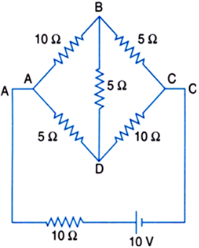
Determine the current in each branch of the network shown in Fig.:
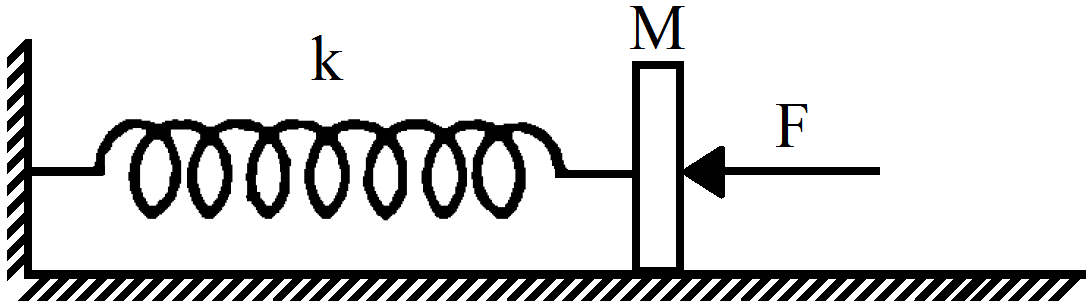
In figure k = 100N/m, M = 1kg and F = 10N,
  1. Find the compression of the spring in the equilibrium position.
  2. A sharp blow by some external agent imparts a speed of 2m/s to the block towards left. Find the sum of the potential energy of the spring and the kinetic energy of the block at this instant.
  3. Find the time period of the resulting simple harmonic motion.
  4. Find the amplitude.
  5. Write the potential energy of the spring when the block is at the left extreme.
  6. Write the potential energy of the spring when the block is at the right extreme.
The answers of (b), (e) and (f) are different. Explain why this does not violate the principle of conservation of energy.