MCQ
Ohm's law fails in
  • A
    Diode
  • B
    Thyristor
  • C
    $PN$ junction system
  • All of these

Answer

Correct option: D.
All of these
d
(d)

Ohm's law is not applicable for diode, thyristor as well as $PN$ junction

Need a full question paper?

Generate a complete, print-ready paper with questions like this in minutes — across 16+ boards, with answer keys.
Start Generating Free

Similar questions

An object of mass $3\,m$ splits into three equal fragments. Two fragments have velocities $v\hat j$ and $v\hat i$. The velocity of the third fragment is
Four resistances of $15\; \Omega, 12\; \Omega, 4 \;\Omega$ and $10\; \Omega$ respectively in cyclic order to form Wheats tone's network. The resistance that is to be connected in parallel with the resistance of $10\; \Omega$ to balance the network is .................. $\Omega$
A uniform rod of length $1\, m$ and mass $4\, kg$ is supported on two knife-edges  placed $10 \,cm$ from each end. A $60\, N$ weight is suspended at $30\, cm$ from  one end. The reactions at the knife edges is
A black body radiates energy at the rate of $1 \times 10^5 J / s \times m^2$ at temperature of $227^o C$. The temperature to which it must be heated so that it radiates energy at rate of $1 \times 10^9J/s m^2$, is
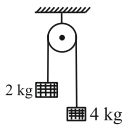
Two blocks of mass $2 \mathrm{~kg}$ and $4 \mathrm{~kg}$ are connected by a metal wire going over a smooth pulley as shown in figure. The radius of wire is $4.0 \times 10^{-5}$ $\mathrm{m}$ and Young's modulus of the metal is $2.0 \times 10^{11} \mathrm{~N} / \mathrm{m}^2$. The longitudinal strain developed in the wire is $\frac{1}{\alpha \pi}$. The value of $\alpha$ is [Use $\mathrm{g}=10 \mathrm{~m} / \mathrm{s}^2$ )
A wheel of radius $r$ rolling on a straight line, the velocity of its centre being $v$ .At a certain instant the point of contact of the wheel with the grounds is $M$ and $N$ is the highest point on the wheel (diametrically opposite to $M$). The incorrect statement is:
The fact that electric charges are integral multiples of the fundamental electronic charge was proved experimentally by
The quantity on which the rise of liquid in capillary tube does not depend upon is
If $w, x, y$ and $z$ are mass, length, time and current respectively, then $\frac{x^2w}{y^3z}$ has dimensional formula same as
Two particles of equal mass are connected to a rope $AB$ of negligible mass such that one is at end $A$ and other dividing the length of rope in the ratio $1:2$ from $B$. The rope is rotated about end $B$ in a horizontal plane. Ratio of tensions in the smaller part to the other is (ignore effect of gravity)