Question
On a certain sum of money, the difference between the compound interest for a year, payable half$-$yearly, and the simple interest for a year is $Rs. 180/-$ Find the sum lent out, if the rate of interest in both the cases is $10\ \%\ $ per annum.
Answer

Let principal $p= Rs. 100 ; R=10\ \%\  ; T=1$ year
$\text { SI }=\frac{100 \times 10 \times 1}{100}=\text { Rs. } 10 \text {. }$
$\mathrm{Cl}$ payable at every 6 months
So, $R=\frac{10}{2}=5 \%$
$I=\frac{100 \times 5 \times 1}{100}=\text { Rs. } 5$
$A=100+5=\text { Rs. } 105$
For second year
$P=\text { Rs. } 105$
$I=\frac{105 \times 5 \times 1}{100}=\text { Rs. } 5.25$
Total compound interest $=5+5.25= Rs. 10.25$
Difference of $\mathrm{Cl}$ and $\mathrm{SI}=10.25-10= Rs. 0.25$
When difference in interest is $Rs. 0.25$ , sum $= Rs. 100 .$
If the difference is $Rs. 1$ then
sum$=\frac{100}{0.25}$
If the difference is $Rs. =180$ then
 sum $=\frac{100}{0.25} \times 180=\text { Rs. } 72,000$

Need a full question paper?

Generate a complete, print-ready paper with questions like this in minutes — across 16+ boards, with answer keys.

Start Generating Free

Similar questions

$AD$ is a median of side $BC$ of $\text{ABC}. E$ is the midpoint of $AD. BE$ is joined and produced to meet $AC$ at $F$. Prove that $AF: AC = 1 : 3$.
Find the area of a triangle whose sides are in the ratio $5:12:13$ and whose perimeter is $36\ cm.$
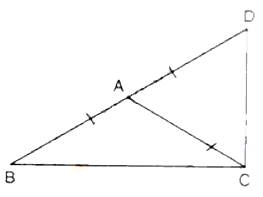
Side $BA$ of an isosceles $\triangle ABC$ is produced so that $AB = AD$. If $AB$ and $AC $are the equal sides of the isosceles triangle, prove that $\angle BCD$ is a right angle.
The sides of a triangular field are in the ratio $5: 3: 4$ and its perimeter is $180\ m$. Find:$(i)$ its area.$(ii)$ the altitude of the triangle corresponding to its largest side.$(iii)$ the cost of leveling the field at the rate of $Rs. 10$ per square meter.
Find the difference between the compound interest and simple interest on $Rs. 20,000$ at $12\%$ per annum for $3$ years, the compound interest being payable annually.
Calculate the area of quadrilateral $\text{ABCD}$, in which $\angle ABD = 90^o$, $\triangle BCD$ is an equilateral triangle of side $24 \ cm$ and $AD = 26 \ cm$.
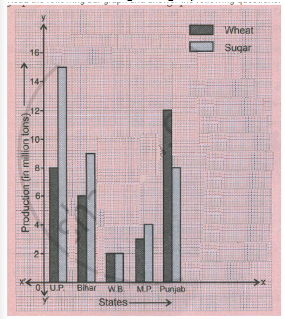
Read the following bar graph and answer the following questions:
Image
$a$. What information is given by the graph?$b$. Which state is the largest producer of wheat?$c$. Which state is the largest producer of sugar?$d$. Which state has total production of wheat and sugar as its maximum?$e$. Which state has the total production of wheat and sugar minimum?
Two circles touch each other externally. The sum of their areas is $58\pi \ cm^2$ and the distance between their centres us $10\ cm$. Find the radii of the two circles.
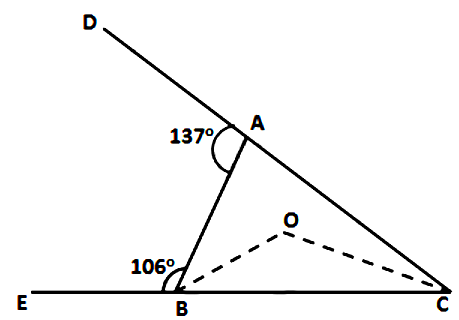
Arrange the sides of $\triangle BOC$ in descending order of their lengths. $BO$ and $C O$ are bisectors of angles $\text{ABC}$ and $\text{ACB}$ respectively.
A motorboat takes 6 hours to cover 100 km downstream and 30 km upstream. If the motorboat goes 75 km downstream and returns back to its starting point in 8 hours, find the speed of the motorboat in still water and the rate of the stream.