On a railway curve, the outside rail is laid higher than the inside one so that resultant force exerted on the wheels of the rail car by the tops of the rails will
Easy
Download our app for free and get started
(a)This horizontal inward component provides required centripetal force.

Download our appand get started for free
Experience the future of education. Simply download our apps or reach out to us for more information. Let's shape the future of learning together!No signup needed.*
Similar Questions
- 1View SolutionA car is moving with high velocity when it has a turn. A force acts on it outwardly because of
- 2A car is moving with a constant speed of $20\,m / s$ in a circular horizontal track of radius $40\,m$. A bob is suspended from the roof of the car by a massless string. The angle made by the string with the vertical will be : (Take $g =10$ $\left.m / s ^2\right)$View Solution
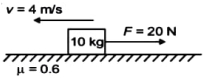
- 3A block of mass $10 kg$ is moving on a rough surface as shown in figure. The frictional force acting on block is ...... $N$View Solution
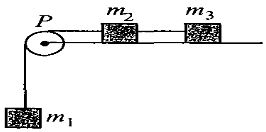
- 4A system consists of three masses $m_1 , m_2$ and $m_3$ connected by a string passing over a pulley $P.$ The mass $m_1$ hangs freely and $m_2$ and $m_3$ are on a rough horizontal table $($the coefficient of friction $= \mu ).$ The pulley is frictionless and of negligible mass. The downward acceleration of mass $m_1$ is $(Assume\, m = m_2 = m_3 = m)$View Solution
- 5A particle has initial velocity $10\,\, m/s$. It moves due to constant retarding force along the line of velocity which produces a retardation of $5\,\, m/s^2$. ThenView Solution
- 6Starting from rest a body slides down a $45^o$ inclined plane in twice the time it takes to slide down the same distance in the absence of friction. The co-efficient of friction between the body and the inclined plane isView Solution
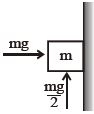
- 7View SolutionA block pressed against the vertical wall is in equilibrium. The minimum coefficient of friction is:-
- 8When a body is placed on a rough plane inclined at an angle $\theta $ to the horizontal, its acceleration isView Solution
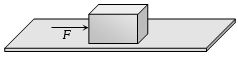
- 9A block of mass $2 \,kg$ is kept on the floor. The coefficient of static friction is $0.4$. If a force F of $2.5$ Newtons is applied on the block as shown in the figure, the frictional force between the block and the floor will be ........ $N$View Solution
- 10View SolutionA passenger inside a bus moving with uniform speed suddenly finds that a ball at rest, starts moving towards his left. It means that the bus now is