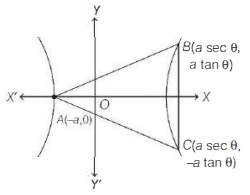
MCQ
On a rectangular hy perbola $x^2-y^2= a ^2, a >0$, three points $A, B, C$ are taken as follows: $A=(-a, 0) ; B$ and $C$ are placed symmetrically with respect to the $X$-axis on the branch of the hyperbola not containing $A$. Suppose that the $\triangle A B C$ is equilateral. If the side length of the $\triangle A B C$ is $k a$, then $k$ lies in the interval
  • A
    $(0,2]$
  • $(2,4]$
  • C
    $(4,6]$
  • D
    $(6,8]$

Answer

Correct option: B.
$(2,4]$
b
(b)

We have rectangular hyperbola

$x^2-y^2=a^2$

Given $A B C$ is an equilateral triangle.

$A B =B C=A C$

$A B^2 =B C^2$

$a^2(\sec \theta+1)^2+a^2 \tan ^2 \theta=4 a^2 \tan ^2 \theta$

$\begin{aligned}(\sec \theta+1)^2 &=3 \tan ^2 \theta \$\sec \theta+1)^2 &=3\left(\sec ^2 \theta-1\right) \$\sec \theta+1)^2 &=3(\sec \theta+1)(\sec \theta-1) \end{aligned}$

$\sec \theta+1=3 \sec \theta-3$

$\sec \theta=2$

$\theta=60^{\circ}$

$\because$ Side $B C=2 a \tan \theta$

$=2 a \tan 6 \theta^{\circ}=2 a \sqrt{3}$

But side of triangle is $k a$.

$k a =2 a \sqrt{3}$

$k =2 \sqrt{3}$

Hence, $k \in(2,4]$.

Need a full question paper?

Generate a complete, print-ready paper with questions like this in minutes — across 16+ boards, with answer keys.

Start Generating Free

Similar questions

For $0 < a < 1$, the value of the integral $\int_0^\pi \frac{\mathrm{d} x}{1-2 \mathrm{a} \cos x+\mathrm{a}^2}$
If $(a, b)$ be the orthocentre of the triangle whose vertices are $(1,2),(2,3)$ and $(3,1)$, and $I_1=\int_a^b x \sin \left(4 x-x^2\right) d x, I_2=\int_a^b \sin \left(4 x-x^2\right) d x$ , then $36 \frac{I_1}{I_2}$ is equal to :
If $a \in R$ and the equation $ - 3{\left( {x - \left[ x \right]} \right)^2} + 2\left( {x - \left[ x \right]} \right) + {a^2} = 0$ (where $[x]$ denotes the greatest integer $\leq\,x$) has no integral solution, then all possible values of $a$ lie in the interval
The sum of last eight consecutive coefficients in the expansion of $(1+x)^{15}$ is
$\smallint \left( {1 + x - \frac{1}{x}} \right){e^{x + \frac{1}{x}}}\;dx = $
The minimum value of the sum of real numbers $a^{-5}, a^{-4}, 3 a^{-3}, 1, a^8$ and $a^{10}$ with $a>0$ is
Let $P(4, -4)$ and $Q(9, 6)$ be two points on the parabola, $y^2 = 4x$ and let $X$ be any point on the arc $POQ$ of this parabola, where $O$ is the vertex of this parabola, such that the area of $\Delta PXQ$ is maximum. Then this maximum Area (in sq. units) is
Let $a_n=\int_{-\pi}^\pi|x-1| \cos n x d x$ for all natural numbers  $n$. Then, the sequence $\left(a_n\right)_{n \geq 0}$ satisfies
Two families with three members each and one family with four members are to be seated in a row. In how many ways can they be seated so that the same family members are not separated ?
The value of $\sum\limits_{r = 0}^{n - 1} {\frac{{^n{C_r}}}{{^n{C_r} + {\,^n}{C_{r + 1}}}}} $ equals