MCQ
On adding $0.1\, M$ solution each of $[Ag^+], [Ba^{2+}], [Ca^{2+}]$ in a $Na_2SO_4$ solution, species first precipitated is $[K_{sp}\, BaSO_4 = 10^{-11}, K_{sp}\, CaSO_4 = 10^{-6}, K_{sp}\,Ag_2SO_4 = 10^{-5}]$
  • A
    $Ag_2SO_4$
  • $BaSO_4$
  • C
    $CaSO_4$
  • D
    All of these

Answer

Correct option: B.
$BaSO_4$
b
The species having minimum value of $K_{sp}$ will get precipitated first of all because ionic product will exceed the solubility product of such a species. The $K_{sp}$ value is minimum for $BaSO_4(10^{-11})$, so, $BaSO_4$ will get precipitated first of all.

Need a full question paper?

Generate a complete, print-ready paper with questions like this in minutes — across 16+ boards, with answer keys.

Start Generating Free

Similar questions

In which compound, the hydrogen bonding is the strongest in its liquid phase
How many geometrical isomers are possible for the above compound ?
What will be the $pH$ value of $0.05 \,M$ $Ba{(OH)_2}$ solution
$2.5 \mathrm{~mL}$ of $\frac{2}{5} \mathrm{M}$ weak monoacidic base $\left(\mathrm{K}_{\mathrm{b}}=1 \times 10^{-12}\right.$ at $\left.25^{\circ} \mathrm{C}\right)$ is titrated with $\frac{2}{15} \mathrm{M} \mathrm{HCl}$ in water at $25^{\circ} \mathrm{C}$. The concentration of $\mathrm{H}^{+}$at equivalence point is $\left(\mathrm{K}_W=1 \times 10^{-14}\right.$ at $\left.25^0 \mathrm{C}\right)$
An equimolar solution of NaNO2​ and HNO2​ can act as a:
The work done during the expansion of a gas from a volume of $4\,d{m^3}$ to $6\,d{m^3}$ against a constant external pressure of $3\,atm$ is ($1\,L\,atm\, = 101.32\,J$) ......$J$
Oxidation number of C in HCCOH is________.
$AlCl_3$ on hydrolysis gives:
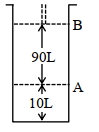
Consider the figure provided.

$1 \mathrm{~mol}$ of an ideal gas is kept in a cylinder, fitted with a piston, at the position $\mathrm{A}$, at $18^{\circ} \mathrm{C}$. If the piston is moved to position $B$, keeping the temperature unchanged, then ' $x$ ' $L$ atm work is done in this reversible process.

$\mathrm{x}=$ . . . . . . $\mathrm{L} \mathrm{atm.} \mathrm{(nearest} \mathrm{integer)}$

[Given : Absolute temperature $={ }^{\circ} \mathrm{C}+273.15$, $\left.\mathrm{R}=0.08206 \mathrm{~L} \mathrm{~atm} \mathrm{~mol}^{-1} \mathrm{~K}^{-1}\right]$
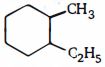
How many geometrical isomers are possible for the above compound ?