On all the six surfaces of a unit cube, equal tensile force of $F$ is applied. The increase in length of each side will be ($Y =$ Young's modulus, $\sigma $= Poission's ratio)
Medium


Download our appand get started for free
Experience the future of education. Simply download our apps or reach out to us for more information. Let's shape the future of learning together!No signup needed.*
Similar Questions
- 1View SolutionWhich one of the following substances possesses the highest elasticity
- 2Two wires of same diameter of the same material having the length $l$ and $2l.$ If the force $ F$ is applied on each, the ratio of the work done in the two wires will beView Solution
- 3View SolutionA solid expands upon heating because
- 4A steel wire of length ' $L$ ' at $40^{\circ}\,C$ is suspended from the ceiling and then a mass ' $m$ ' is hung from its free end. The wire is cooled down from $40^{\circ}\,C$ to $30^{\circ}\,C$ to regain its original length ' $L$ '. The coefficient of linear thermal expansion of the steel is $10^{-5} { }^{\circ}\,C$, Young's modulus of steel is $10^{11}\, N /$ $m ^2$ and radius of the wire is $1\, mm$. Assume that $L \gg $ diameter of the wire. Then the value of ' $m$ ' in $kg$ is nearlyView Solution
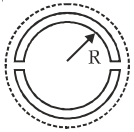
- 5A wooden wheel of radius $R$ is made of two semicircular part (see figure). The two parts are held together by a ring made of a metal strip of cross section area $S$ and length $L$. $L$ is slighly less than $2\pi R$. To fit the ring on the wheel, it is heated so that its temperature rises by $\Delta T$ and it just steps over the wheel.As it cools down to surronding temperature, it presses the semicircular parts together. If the coefficint of linear expansion of the metal is $\alpha$, and its young's modulus is $Y$, the force that one part of wheel applies on the other part isView Solution
- 6When a pressure of $100$ atmosphere is applied on a spherical ball, then its volume reduces to $0.01\%$. The bulk modulus of the material of the rubber in $dyne/c{m^2}$ isView Solution
- 7If the breaking force for a given wire is $F$, then the breaking force of two wires of same magnitude will beView Solution
- 8The normal density of a material is $\rho$ and its bulk modulus of elasticity is $K$. The magnitude of increase in density of material, when a pressure $P$ is applied uniformly on all sides, will beView Solution
- 9The pressure that has to be applied to the ends of a steel wire of length $10\ cm$ to keep its length constant when its temperature is raised by $100^o C$ is: (For steel Young's modulus is $2 \times 10^{11}$ $Nm^{-1}$ and coefficient of thermal expansion is $1.1 \times 10^{-5}$ $K^{-1}$ )View Solution
- 10A sphere contracts in volume by $0.01 \%$ when taken to the bottom of sea $1 \,km$ deep. Find Bulk modulus of the material of sphere ........... $N / m ^2$View Solution