MCQ
On bromination, propionic acid yields two isomeric $2-$bromopropionic acids. This pair is an important example of
  • A
    Chain isomers
  • Optical isomers
  • C
    Cis-trans isomers
  • D
    Position isomers

Answer

Correct option: B.
Optical isomers
b
Optical isomers

Need a full question paper?

Generate a complete, print-ready paper with questions like this in minutes — across 16+ boards, with answer keys.

Start Generating Free

Similar questions

How many $mL$ of $0.2\, M\, KCN$ should be mixed with $200\, mL$ of $0.1\, M\, HCN$ so as to make a mixture of $pH = 3$ ($pK_a$ for $HCN = 6$) ? ......$mL$
A gas undergoes change from state $A$ to state $B$. In this process, the heat absorbed and work done by the gas is $5\, J$ and $8\, J$, respectively. Now gas is brought back to $A$ by another process during which $3\, J$ of heat is evolved. In this reverse process of $B$ to $A$
Metal oxides which decomposes on heating is
For the following Assertion and Reason, the correct option is

Assertion : The $pH$ of water increases with increase in temperature.

Reason : The dissociation of water into $H^+$ and $OH^-$ is an exothermic reaction.

$\mathrm{A}_{(\mathrm{g})} \rightleftharpoons \mathrm{B}_{(\mathrm{g})}+\frac{\mathrm{C}}{2}(\mathrm{~g}) \quad$ The correct relationship between $K_P, \alpha$ and equilibrium pressure $P$ is
The solubility of silver bromide in hypo solution is due to the formation of
Rank the following species in order of decreasing nucleophilicity in a polar protic  solvent (most $\to$ least nucleophilic)

$\underset{(1)}{\mathop{C{{H}_{3}}C{{H}_{2}}C{{H}_{2}}{{O}^{-}}}}\,\,\,\,\,\,\underset{(2)}{\mathop{C{{H}_{3}}C{{H}_{2}}C{{H}_{2}}{{S}^{-}}}}\,\,\,\,\underset{(3)}{\mathop{\begin{matrix}
   \,\,\,\,\,\,\,O  \\
   \,\,\,\,\,\,\,\,||  \\
   C{{H}_{3}}C{{H}_{2}}C-{{O}^{-}}  \\
\end{matrix}}}\,$

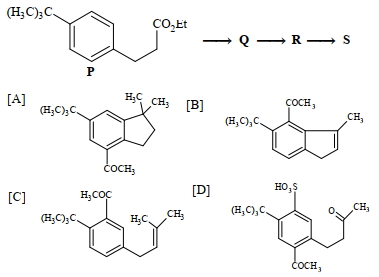
The reaction of compound $\mathbf{P}$ with $CH_3 MgBr$ (excess) in $\left(C_2 \mathrm{H}_5\right)_2 O$ followed by addition of $H_2 O$ gives $Q$. The compound $Q$ on treatment with $H_2 SO_4$ at $0^{\circ} C$ gives $R$. The reaction of $R$ with $CH_3 COC1$ in the presence of anhydrous $AlCl_3$ in $CH_2 Cl_2$ followed by treatment with $H_2 O$ produces compound $S$ [ $Et$ in compound $P$ is ethyl group]

(image)

($1$) The product $S$ is

(image)

($2$) The reactions, $Q$ to $R$ and $R$ to $S$, are

$[A]$ Dehydration and Friedel-Crafts acylation

$[B]$ Aromatic sulfonation and Friedel-Crafts acylation

$[C]$ Friedel-Crafts alkylation, dehydration and Friedel-Crafts acylation

$[D]$ Friedel-Crafts alkylation and Friedel-Crafts acylation

Given the answer quetion ($1$) and ($2$)
In which reaction product is hydrocarbon ?
Which optically active compound on reduction with $LiAlH_4$ will give optically inactive compound ?