MCQ
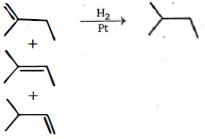
On catalytic reduction $(H_2/Pt)$ how many alkenes will give $2$ -methylbutane ?
  • A
    $1$
  • B
    $2$
  • $3$
  • D
    $4$

Answer

Correct option: C.
$3$
c

Need a full question paper?

Generate a complete, print-ready paper with questions like this in minutes — across 16+ boards, with answer keys.

Start Generating Free

Similar questions

The most basic element is
An atom has the electronic configuration of $1{s^2},2{s^2}2{p^6}$, $3{s^2}3{p^6}3{d^{10}},4{s^2}4{p^5}$. Its atomic weight is $ 80.$  Its atomic number and the number of neutrons in its nucleus shall be
Which of the nitrogen oxides is obtained when ammonium nitrate is heated ?
Which of the following compound gives dye test
Which of the following kinds of isomerism can nitroethane exhibit ?
Alcohol is not formed as product in
Consider the following statements
$I.$ The radius of an anion is larger than that of the parent atom.

$II.$ The ionization energy generally increases with increasing atomic number in a period.

$III.$ The electronegativity of an element is the tendency of an isolated atom to attract an electron.

Which of the above statements is/are correct?

Upon heating $KClO_3$ in the presence of catalytic amount of $MnO_2$, a gas $W$ is formed. Excess amount of $W$ reacts with white phosphorus to give $X$. The reaction of $X$ with $HNO_3$ gives $Y$ and $Z$.

($1$)  $W$ and $\mathbf{X}$ are, respectively

$[A]$ $O_3$ and $P_4 O_6$   $[B]$ $O_2$ and $P_4 O_6$   $[C]$ $O_2$ and $P_4 O_{10}$    $[D]$ $O_3$ and $P_4 O_{10}$

($2$) $Y$ and $Z$ are, respectively

$[A]$ $N_2 O_3$ and $\mathrm{H}_3 \mathrm{PO}_4$

$[B]$ $N_2 O_5$ and $\mathrm{HPO}_3$

$[C]$ $N_2 O_4$ and $HPO_3$

$[D]$ $N_2 O_4$ and $H_3 PO_3$

Give the answer of quetion ($1$) and ($2$)

The correct order of the decreasing ionic radii among the following isoelectronic species is
Which of the following solutions can act as buffer