MCQ
On decreasing the temperature, surface tension:
  • Increases
  • B
    Decreases
  • C
    Remains unchanged
  • D
    None of these

Answer

Correct option: A.
Increases
A

Need a full question paper?

Generate a complete, print-ready paper with questions like this in minutes — across 16+ boards, with answer keys.
Start Generating Free

Similar questions

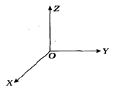
A force of $-F$$\hat k$ acts on $O$, the origin of the coordinate system. The torque about the point $(1, -1)$ is
What is the moment of inertia of a square sheet of side $l$ and mass per unit area $\mu $ about an axis passing through the centre and perpendicular to its plane
$Assertion$ : The dimensional formula for relative velocity is same as that of the change in velocity.

$Reason$ : Relative velocity of $P$  w.r.t. $Q$ is the ratio of velocity of $P$ and that of $Q$.
A bimetallic strip is made of aluminium and steel $(\alpha_\text{At}>\alpha_{\text{steel}}).$ On heatinh, the strip will:
  1. Remain straight.
  2. Get twisted.
  3. Will bend with aluminium on concave side.
  4. Will bend with steel on concave side.
One kg of a diatomic gas is at a pressure of $8 \times 10^4$  $N/m^2$ The density of the gas is $4$ $kg/m^3$ What is the energy (in $\times 10^4\; J$) of the gas due to its thermal motion?
Three bodies having masses $5\, kg , 4\, kg$ and $2 \,kg$ is moving at the speed of $5\, m / s , 4\, m / s$ and $2 \,m / s$ respectively along $X -$axis. The magnitude of velocity of centre of mass is (in $m/s$)
The moment of inertia of semicircular ring about an axis, passing through the center and perpendicular to the plane of ring, is $\frac{1}{ x } MR ^2$, where $R$ is the radius and $M$ is the mass of semicircular ring. The value of $x$ will be $...........$
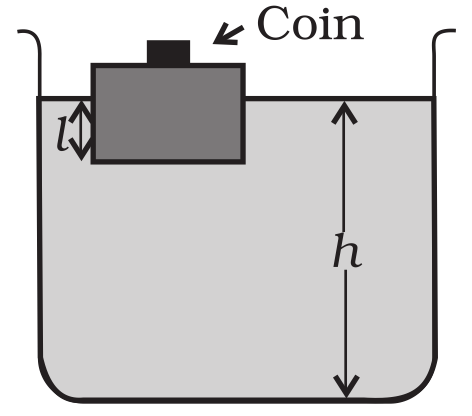
A wooden block with a coin placed on its top, floats in water as shown in the distance l and h are shown in the figure. After some time the coin falls into the water. Then:

  1. l decreases.
  2. h decreases.
  3. l increases.
  4. h increase.
In a streamline flow:
  1. The speed of a particle always remains same.
  2. The velocity of a particle always remains same.
  3. The kinetic energies of all the particles arriving at a given point are the same.
  4. The momenta of all the particles arriving at a given point are the same.
A body falling vertically downwards under gravity breaks in two parts of unequal masses. The centre of mass of the two parts taken together shifts horizontally towards:
  1. Heavier piece.
  2. Lighter piece.
  3. Does not shift horizontally.
  4. Depends on the vertical velocity at the time of breaking.