MCQ
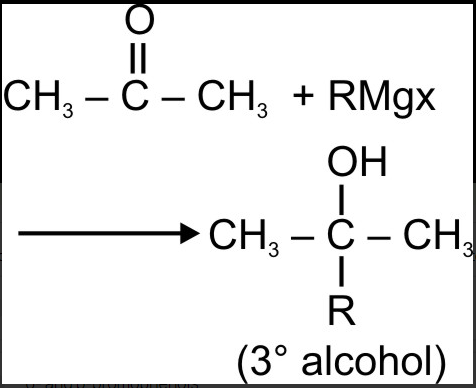
On reacting with grignard reagent acetone gives?
  • A
    10alcohol
  • B
    20alcohol
  • C
    30alcohol
  • D
    None of these

Answer

  1. 30alcohol

Explanation:

Need a full question paper?

Generate a complete, print-ready paper with questions like this in minutes — across 16+ boards, with answer keys.

Start Generating Free

Similar questions

The standard reduction potentials of $Cu^{2+},\,Zn^{2+},\,Sn^{2+}$ and $Ag^+$ are $0.34,\,-0.76,\, - 0.14$ and $0.80\ V$ respectively. The storage that is possible without any reaction is for (under standard condition) :
Noble gases are group of elements which exhibit very
The standard potential of a $Co^{+2}\,|\, Co$ electrode is $-0.28\, V$ and the standard potential of the cell $Pt\,|\,T{i^{2 + }}\left( {aq.} \right),\,T{i^{3 + }}\left( {aq.} \right)\,||\,C{o^{2 + }}\left( {aq.} \right)\,|\,Co\left( s \right)$ is $0.09\,V$. what is the standard potential of the $Ti_{\left( {aq.} \right)}^{2 + }\,|Ti_{\left( {aq.} \right)}^{3 + }$ electrode ........... $\mathrm{V}$
If freezing point of an aqueous urea solution is $271.14\,K$ at $1$ atmospheric pressure (if $K_f$ of water = $1.86\,K/m$) then what should be mole fraction of urea in this solution? (Freezing point of water is $273\,K$)
Arrange the following in decreasing order of $BP$

$CH_3CHO$ $( I )$, $CH_3CH_2OH$ $( II )$

$CH_3OCH_3$ $( III )$, $CH_3CH_2CH_3$ $( IV )$

Aqueous solutions of hydrogen sulphide and sulphur dioxide when mixed together, yield
$1-2-$ dichloro ethane $+ NaSCH_2 CH_2SNa \to C_4H_8S_2 + (P)$ 

Unknown  product $(P)$ of the above reaction is
Rectified spirit obtained by fermentation contains $4.5$ $\%$ of water. So in order to remove it, rectified spirit is mixed with suitable quantity of benzene and heated. Benzene helps because
Which of the following does not reduce Benedict's solution
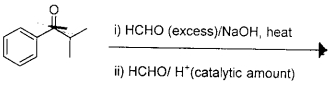
The major product of the following reaction sequence is