MCQ
On the Celsius scale the absolute zero of temperature is at  .......... $^oC$ 
  • A
    $0$
  • B
    $-32$
  • C
    $100$
  • $-273.15$

Answer

Correct option: D.
$-273.15$
d
(d) $T = 273.15 + t^\circ C$ $\Rightarrow$ $0 = 273.15 + t^\circ C$ $\Rightarrow$ $t = - 273.15^\circ C$

Need a full question paper?

Generate a complete, print-ready paper with questions like this in minutes — across 16+ boards, with answer keys.

Start Generating Free

Similar questions

The speed of a projectile at its maximum height is $\frac {\sqrt 3}{2}$ times its initial speed. If the range of the projectile is $P$ times the maximum height attained by it, $P$ is equal to
An open water tight railway wagon of mass $5 \times 10^3 kg$ coasts at an initial velocity $1.2 m/s$ without friction on a railway track. Rain drops fall vertically downwards into the wagon. The velocity of the wagon after it has collected $10^3 kg$ of water will be .............. $\mathrm{m}/ \mathrm{s}$
A rod of length $L$ at room temperature and uniform area of cross section $A$, is made of a metal having coefficient of linear expansion $\alpha {/^o}C$. It is observed that an external compressive force $F$, is applied on each of its ends, prevents any change in the length of the rod, when it temperature rises by $\Delta \,TK$. Young’s modulus, $Y$, for this metal is
A wheel of radius $r$ rolling on a straight line, the velocity of its centre being $v$ .At a certain instant the point of contact of the wheel with the grounds is $M$ and $N$ is the highest point on the wheel (diametrically opposite to $M$). The incorrect statement is:
Consider $1 \,kg$ of liquid water undergoing change in phase to water vapour at $100^{\circ} C$. At $100^{\circ} C$, the vapour pressure is $1.01 \times 10^5 \,N - m ^2$ and the latent heat of vaporization is $22.6 \times 10^5 \,Jkg ^{-1}$. The density of liquid water is $10^3 \,kg m ^{-3}$ and that of vapour is $\frac{1}{1.8} \,kg m ^{-3}$. The change in internal energy in this phase change is nearly ............ $\,J kg ^{-1}$
If a tunnel is cut at any orientation through earth, then a ball released from one end will reach the other end in time ........ $\min$ (neglect earth rotation)
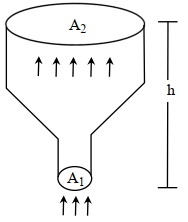
An ideal gas of density $\rho=0.2 kg m ^{-3}$ enters a chimney of height $h$ at the rate of $\alpha=0.8 kg s ^{-1}$ from its lower end, and escapes through the upper end as shown in the figure. The cross-sectional area of the lower end is $A_1=0.1 m ^2$ and the upper end is $A_2=0.4 m ^2$. The pressure and the temperature of the gas at the lower end are $600 Pa$ and $300 K$, respectively, while its temperature at the upper end is $150 K$. The chimney is heat insulated so that the gas undergoes adiabatic expansion. Take $g=10 ms ^{-2}$ and the ratio of specific heats of the gas $\gamma=2$. Ignore atmospheric pressure.

Which of the following statement($s$) is(are) correct?
What is the value of linear velocity, if $\vec \omega = 3\hat i - 4\hat j + \hat k$ and $\vec r = 5\hat i - 6\hat j + 6\hat k$
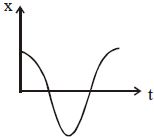
Dispacement time graph of a particle executing $SHM$ is as shown in the figure. Corresponding graph between $PE$ and time is