Question
On what factors does the resistance of a conductor depend?

Answer

Factors on which the resistance of a conductor depends:
  1. Length of conductor: Resistance is directly proportional to the length of the conductor. This means Resistance increases with an increase in the length of the conductor. This is the cause that long electric wires create more resistance to the electric current.
  2. Area of cross-section: Resistance is inversely proportional to the area of the cross-section of the conductor. This means Resistance will decrease with an increase in the area of the conductor and vice versa. This is the cause that thick copper wire creates less resistance to the electric current.
  3. Temperature: Resistance is directly proportional to the temperature.
  4. Nature of material: Some materials create the least hindrance and hence are called good conductors. Silver is the best conductor of electricity. While some other materials create more hindrance in the flow of electric current, i.e. flow of electrons through them. Such materials are called bad conductors. Bad conductors are also known as insulators. The hard plastic is one of the best insulators of electricity.

Need a full question paper?

Generate a complete, print-ready paper with questions like this in minutes — across 16+ boards, with answer keys.

Start Generating Free

Similar questions

An electric bulb is rated 250 W, 230 V.

(i) the energy consumed in one hour, and

(ii) the time in which the bulb will consume 1.0 kWh energy when connected to 230 V mains.
What is the difference between mass and weight?
(a)A ray of light is incident at 45° on the face of
(i) A rectangular block of glass.
(ii) A $60^0$ glass prism.
(b) Draw a sketch showing how the ray of monochromatic ray of light passes through glass in each case.
(c) With the aid of a diagram, explain how the face of a right angled prism may totally reflect incident on it.
(d) A thick plane mirror produces several faint images in addition to a prominent one. Draw a ray diagram showing how reflection and refraction produce all these images.
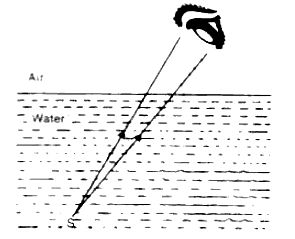
(e) Fig. represents a stone S at the bottom of a pond of water. Using the two rays, as shown, complete the ray diagram to show where the image of the stone appears when viewed from E.

(f) What is a''mirage'? Explain with the help of a diagram.
(g) A man observes the bottom of a swimming pool of $3 \ m$ depth. If the refractive index of water is $1.3,$ what is the apparent depth of water?
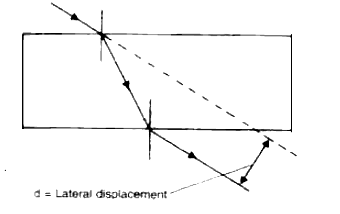
(h) When a ray of light undergoes refraction through a glass slab and when it emerges it is displaced laterally (Fig). What are the factors on which the lateral displacement depends?

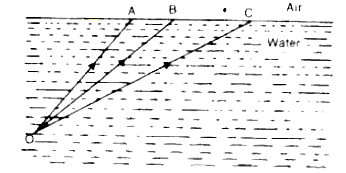
(i) Fig. shows three rays of light $OA, OB$ and $OC$ passing from water to air, making angles $49^0, 41^0$ and $35^0$​​​​​​​ with the horizontal surface respectively. Draw an approximate path of the emergent ray for each. (Critical angle of water is $49^0​​​​​​​$.)
A bulb is marked $100W, 220V$ and an electric heater is marked $2000 W, 220 V.$
(i) What is the ratio between the resistances of these two devices?
(ii) How does the power-voltage rating of a device help us to decide about the type of leads (connecting wires) to be used for it?
(iii) In which of the above two devices, a thicker connecting wire of lead is required?
Draw neat diagrams for the formation of images in case of concave lens and state their characteristics when the object is:
(a) at infinity,
(b) anywhere between infinity and the optical centre
 A battery o f e.m.f. 3 Vis connected in series with an ammeter, a $10 \Omega$ coil of wire and with a parallel combination of resistance of $3 \Omega$ and $6 \Omega$. Draw a circuit diagram for the above arrangement. What is the
(a) Resistance of the parallel combination?
(b) Reading on the ammeter?
(c) Potential difference across the $3 \Omega$ resistor?
(d) Current flowing through each resistor?
A current-carrying solenoid is suspended so as to freely rotate in a horizontal plane. State in what direction will it rest. Give a reason for your answer.

or

When a solenoid that is carrying current is freely suspended, it comes to rest in a particular direction. Why does this happen?

Two resistors of 2.0 Ω and 3.0 Ω are connected (a) in series (b) in parallel, with a battery of 6.0 V and negligible internal resistance. For each case draw a circuit diagram and calculate the current through the battery.
It is dangerous to connect the switch in the neutral wire. Explain your answer.
State Fleming's left handle rule.