Question
On what factors is induced current in a coil depends?

Answer

Induced current depends on: (i) Number of turns in the coil (ii) Resistance of the coil and (iii) Rate of change of flux in the coil.

Need a full question paper?

Generate a complete, print-ready paper with questions like this in minutes — across 16+ boards, with answer keys.
Start Generating Free

Similar questions

The value of electric flux through a closed surface is zero. What does this mean?
Answer carefully:Two large conducting spheres carrying charges $Q_1$ and $Q_2$ are brought close to each other. Is the magnitude of electrostatic force between them exactly given by $\frac{\text{Q}_1\text{Q}_2}{{4}\pi\in_{0}\text{r}^{2}}$, where r is the distance between their centres?
Is Archimedes' principle valid in elevator accelerating up? In acar acccelerating on a level road?
How does the angle of minimum deviation of a glass prism vary, if the incident violet light is replaced by red light? Give reason.
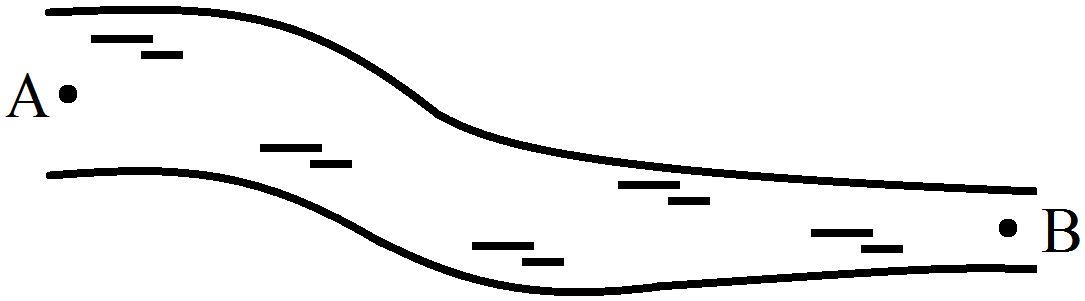
Water flows through a tube shown in The areas of cross-section at A and B are $1cm^2$ and $0.5cm^2$ respectively. The height difference between A and B is 5cm. If the speed of water at A is 10cm/s find.
  1. The speed at B.
  2. The difference in pressures at A and B.
A rod of rest length L moves at a relativistic speed. $\text{L}=\frac{\text{L}}{\curlyvee}.$ Let Its length:
  1. Must be equal to L.
  2. May be equal to L.
  3. May be more than L' but less than L.
  4. May be more than L.
When electrons drift in a metal from lower to higher potential, does it mean that all the free electrons of the metal are moving in the same direction?
Name the physical quantity whose S.I. unit is $\mathrm{JC}^{-1}$. Is it a scalar or a vector quantity?
Which property of light is confirmed by the pattern of polarization?
Answer the following:
What are the forms of energy into which the electrical energy of the atmosphere is dissipated during a lightning?
(Hint: The earth has an electric field of about $100 \mathrm{Vm}^{-1}$ at its surface in the downward direction, corresponding to a surface charge density $=-10^{-9} \mathrm{Cm}^{-2}$. Due to the slight conductivity of the atmosphere up to about 50 km (beyond which it is good conductor), about +1800 C is pumped every second into the earth as a whole. The earth, however, does not get discharged since thunderstorms and lightning occurring continually all over the globe pump an equal amount of negative charge on the earth.)