MCQ
Oncontrolled hydrolysis and condensation, ${R_3}SiCl$ yields
  • ${R_3}Si - O - Si{R_3}$
  • B
    ($\,{R_3}Si - O - Si{R_3}\,$)$n$
  • C
    ${R_3}SiOH$
  • D
    $\mathop {\mathop {\mathop {\mathop {\mathop {\mathop {|\,\,\,\,\,\,\,\,\,\,\,\,\,\,\,\,\,|}\limits_{O\,\,\,\,\,\,\,\,\,\,\,\,\,\,O} }\limits_{ - Si - O - Si - } }\limits_{|\,\,\,\,\,\,\,\,\,\,\,\,\,\,\,\,|\,} }\limits^{ - Si\,\, - \,O\,\, - Si\, - } }\limits^{|\,\,\,\,\,\,\,\,\,\,\,\,\,\,\,\,\,\,|} }\limits^{R\,\,\,\,\,\,\,\,\,\,\,\,\,\,\,\,R} $
Answer

Correct option: A.
${R_3}Si - O - Si{R_3}$
a
(a) ${R_3}SiCl$ on hydrolysis forms only a dimer.

${R_3}SiOH + HOSi{R_3} \to {R_3}Si - O - Si{R_3}$.

Need a full question paper?

Generate a complete, print-ready paper with questions like this in minutes — across 16+ boards, with answer keys.

Start Generating Free

Similar questions

The element that does not belong to the same period of the remaining elements (modern periodic table) is:
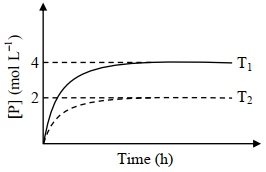
In a one-litre flask, 6 moles of $A$ undergoes the reaction $A(\mathrm{~g}) \rightleftharpoons \mathrm{P}(\mathrm{g})$. The progress of product formation at two temperatures (in Kelvin), $\mathrm{T}_1$ and $\mathrm{T}_2$, is shown in the figure:

If $T_1=2 T_2$ and $\left(\Delta G_2^{\Theta}-\Delta G_1^{\varphi}\right)=R T_2 \ln x$, then the value of $x$ is. . . . .

$\left[\Delta G_1^\theta\right.$ and $\Delta G_2^\theta$ are standard Gibb's free energy change for the reaction at temperatures $T_1$ and $T_2$, respectively.]

If shortest wavelength of $He^+$ ion in Balmer series is $X\,metres$ then longest wavelength in Paschen series of $Li^{+2}$ ion is
For elements $B , C , N , Li , Be , O$ and $F$ the correct order of first ionization enthalpy is
$2.0\,molar$ solution is obtained , when $ 0.5\,mole$ solute is dissolved in
$4-$chloro$-3, 5-$dimethyl phenol is called
With reference to aqua regia, choose the correct option($s$).

$(1)$ Reaction of gold with aqua regia produces $NO _2$ in the absence of air

$(2)$ Aqua regia is prepared by mixing conc. $HCl$ and conc. $HNO _3$ in $3: 1$ ($v/v$) ratio

$(3)$ Reaction of gold with aqua regia produces an anion having $Au$ in +$3$ oxidation state

$(4)$ The yellow colour of aqua regia is due to the presence of $NOCl$ and $Cl _2$

$20\,g$ of hydrogen is present in $5\,litre$ vessel. The molar concentration of hydrogen is
Which one of the following arrangements represents the correct order of the proton affinity of the given species
The halogen that most easily reduced is