MCQ
One ampere is equal to :
  • $ \frac{1~Coulomb}{1~Second} $
  • B
    $ 1~Coulomb \times 1~Second $
  • C
    $ 1~Volt \times 1~Ohm $
  • D
    $ \frac{1~Ohm}{1~Volt} $

Answer

Correct option: A.
$ \frac{1~Coulomb}{1~Second} $
A

Need a full question paper?

Generate a complete, print-ready paper with questions like this in minutes — across 16+ boards, with answer keys.
Start Generating Free

Similar questions

An electromagnetic wave travelling along z-axis is given as: $\text{E}=\text{E}_0\cos(\text{kz}-\omega\text{t})$. Choose the correct options from the following;
The dispersive powers of glasses of lenses used in an achromatic pair are in the ratio 5 : 3. If the focal length of the concave lens is 15 cm, then the nature and focal length of the other lens would be(a) Convex, 9 cm(b) Concave, 9 cm(c) Convex, 25 cm(d) Concave,  25 cm
       
An electrically maintained tuning fork vibrates with constant frequency and constant amplitude. If the temperature of the surrounding air increases but pressure remains constant, the sound produced will have:
  1. Larger wavelength.
  2. Larger frequency.
  3. Larger velocity.
  4. Larger time period.
A triode whose mutual conductance is 2.5 m A/volt and anode resistance is 20 kilo ohm, is used as an amplifier whose amplification is 10. The resistance connected in plate circuit will be(a) 1 kW  (b) 5 kW(c) 10 kW(d) 20 kW
       
When two deuterium nuclei fuse together to form a tritium nuclei, we get a(a) Neutron(b) Deutron(c) α - particle(d) Proton
       
An electric current i enters and leaves a uniform circular wire of radius a through diametrically opposite points. A charged particle q moving along the axis of the circular wire passes through its centre at speed v. The magnetic force acting on the particle when it passes through the centre has a magnitude:
  1. $\text{qv}\frac{\mu_0\text{i}}{2\text{a}}$
  2. $\text{qv}\frac{\mu_0\text{i}}{2\pi\text{a}}$
  3. $\text{qv}\frac{\mu_0\text{i}}{\text{a}}$
  4. $\text{Zero}$
A hydrogen atom in ground state absorbs $10.2eV$ of energy. The orbital angular momentum of the electron is increased by:
'Mirage' is a phenomenon due to(a) Reflection of light(b) Refraction of light(c) Total internal reflection of light(d) Diffraction of light
   
   
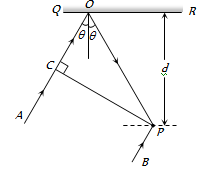
In the adjacent diagram, $CP$ represents a wavefront and $AO\ \&\ BP,$ the corresponding two rays. Find the condition on $q$  for constructive interference at $P$ between the ray $BP$ and reflected ray $OP$
The SI unit of an electric charge is: