Question
One astronomical unit is a distance equal to ...... $m$

Answer

(b)

One astronomical unit is the average distance between earth and sun

$1 \text { astronomical unit }( AU )=1.496 \times 10^{11} \,m$

Need a full question paper?

Generate a complete, print-ready paper with questions like this in minutes — across 16+ boards, with answer keys.
Start Generating Free

Similar questions

If $\theta$ is angle between the velocity and acceleration of a particle moving on a circular path with decreasing speed, then .........
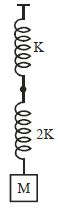
Two springs of force constant $K$ and $2K$ are connected to a mass as shown below. The frequency of oscillation of the mass is
A piece of ice (heat capacity $=2100 \mathrm{~J} \mathrm{~kg}^{-1}{ }^{\circ} \mathrm{C}^{-1}$ and latent heat $=3.36 \times 10^5 \mathrm{~J} \mathrm{~kg}^{-1}$ ) of mass $\mathrm{m}$ grams is at $-5^{\circ} \mathrm{C}$ at atmospheric pressure. It is given $420 \mathrm{~J}$ of heat so that the ice starts melting. Finally when the ice-water mixture is in equilibrium, it is found that $1 \ \mathrm{gm}$ of ice has melted. Assuming there is no other heat exchange in the process, the value of $m$ is
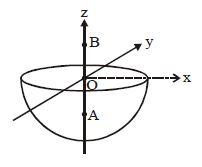
Consider $a$ uniformly charged hemispherical shell of radius $R$ and charge $Q$ . If field at point $A (0, 0, -z_0)$ is $ \vec E$ then field at point $(0, 0, z_0)$ is $[z_0 < R]$ 
Which of the following statements are correct ?

$(a)$ Centre of mass of a body always coincides with the centre of gravity of the body

$(b)$ Central of mass of a body is the point at which the total gravitational torque on the body is zero

$(c)$ A couple on a body produce both translational and rotation motion in a body

$(d)$ Mechanical advantage greater than one means that small effort can be used to lift a large load

A current $I$ flows in an infinitely long wire with cross-section in the form of a semicircular ring of radius $R$ . The magnitude of the magnetic induction along its axis is
An astronaut takes a ball of mass $m$ from earth to space. He throws the ball into a circular orbit about earth at an altitude of $318.5 \mathrm{~km}$. From earth's surface to the orbit, the change in total mechanical energy of the ball is $x \frac{\mathrm{GM}_e \mathrm{~m}}{21 R_e}$. The value of $x$ is (take $R_{\mathrm{e}}=6370 \mathrm{~km}$ ):
A wave represented by the given equation $y = a\cos (kx - \omega \,t)$ is superposed with another wave to form a stationary wave such that the point $x = 0$ is a node. The equation for the other wave is
A body is moving on a circle of radius $80 \,m$ with a speed $20 \,m / s$ which is decreasing at the rate $5 \,m / s ^2$ at an instant. The angle made by its acceleration with its velocity is ..........
A photon of $1.7 \times {10^{ - 13}}$ Joules is absorbed by a material under special circumstances. The correct statement is